ENTRY VISA
Type of Indonesia Visa
Indonesia is extensively preparing for a tourism recovery in the near future as the government is putting their utmost effort to flatten the curve of pandemic through the acceleration of vaccination programs and the implementation of community restrictions. Currently,
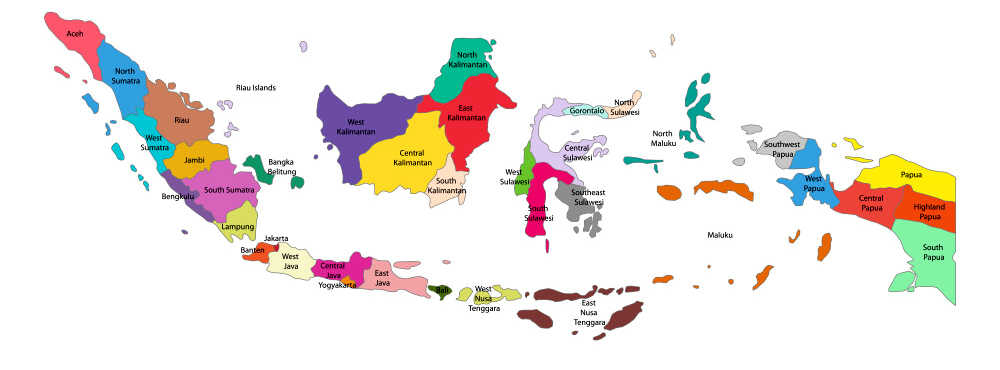
Indonesia has decided to reopen Bali and Riau Islands for visitors with terms and conditions applying. Before planning your trip to Indonesia, complete your basic preparation by learning about the visa and requirements to enter Indonesia (Read also Travel Regulations to Indonesia 2023)
E-Visa
In order to provide ease of access, the Indonesian Ministry of Law and Human Rights has developed an electronic visa (e-Visa) application system. This e-Visa aims to facilitate foreign travelers who are planning to visit Indonesia in the future and bring a positive impact on the development of tourism and creative economy of Indonesia.
The e-Visa application system allows foreigners to apply for a visa online without having to visit the Republic of Indonesia Representative out of the country or the Immigration Office. You can visit this article to find out more information about e-Visa.
The government has also launched the Electronic Visa on Arrival (eVOA) program on 10 November, 2022, to provide an even easier entry process for foreign travelers.
According to the Circular Letter of the Directorate General of Immigration No. IMI-0794.GR.01.01 of 2022 concerning the Immigration Policy regarding Electronic Visit Visa Services, Visit Visa on Arrival Services, and Free Visit Visa to Support Sustainable Tourism during the Covid-19 Pandemic, as of 1 December 2022, the eVOA program is accessible to foreign nationals from 86 countries. The eVOA is available at 16 airports, 91 seaports, as well as 6 cross-border immigration checkpoints across Indonesia.
You can visit this link to find out the complete list of the eligible countries and the entrance points across Indonesia where the eVOA is available. As for the registration, you can head on to this page to gather more details about it.
Type of Visas
Before applying for a visa to Indonesia, you need to identify your purpose of visit in order to know what kind of visa you need. Based on the
Decree of the Minister of Law and Human Rights (KEPMENKUMHAM) No. M.HH-03.GR.01.05 of 2021, here are the current types of visas you can apply for.
According to the Circular Letter of the Directorate General of Immigration No. IMI-0708.GR.01.01 of 2022 concerning the Ease of Immigration to Support Sustainable Tourism during the COVID-19 Pandemic effective from 23 September 2022, the Indonesian government has implemented a Visa Exemption Arrangement facility to 9 countries. You can visit this link to find out the complete list of countries eligible for Visa Exemption Arrangement.
Furthermore, on 25 October 2022, The Directorate General of Immigration (DGI) Ministry of Law and Human Rights officially launched the Second Home Visa, which details are stated in Circular Number IMI-0740.GR.01.01 of 2022 concerning the Granting of a Second-Home Visa and Temporary Stay Permit.
You can visit this link for further information regarding types of visa that are applicable in indonesia.
Latest Travel Regulations
On 15 September 2022, the government started applying the Visa On Arrival (VOA) program for 86 selected countries as well as the Visa Exemption Facility for 9 selected countries.
As a way to support the tourism recovery in Indonesia, the Indonesian Government will make sure to keep their utmost efforts to prevent the spread of COVID-19, namely by maintaining the status as one of countries with the highest vaccination rates, as well as the country that consistently provides safety protocols for all of its visitors.
Visit this link to gather more information about the latest travel regulations that currently apply in Indonesia.
Note that this regulation is dynamic and can be changed from time to time, so that travelers need to recheck and confirm before planning their future journey.
We hope that this information can assist you in preparing your next journey to Indonesia. We kindly ask you to stay safe by always practicing healthy habits such as washing hands frequently, wearing a mask in public, and implementing social distancing. See you soon in the near future.
Do also follow our Instagram @wonderfulindonesia, Facebook @WonderfulIndonesia, Twitter @wonderfulid, TikTok @wonderfulid, and subscribe to our Youtube Wonderful Indonesia so you don’t miss out on any news regarding Indonesia’s travel regulations and awe-inspiring destinations.
Disclaimer: This article was updated on January 16, 2023. Due to the dynamic nature of travel regulations, please keep yourself updated by following our social media accounts.

GETTING TO INDONESIA
Am I familiar with the visa and immigration policies of Indonesia?
Before departing on your exciting adventure across the various wonders of Indonesia, be sure you have all the necessary travel documents that you will need to bring along on your trip. It will also be wise if you are well aware of all the information regarding immigration and visas to Indonesia from your home country to avoid all the unnecessary inconveniences.
Please refer to our Visa and Immigration information page to learn about the entry information to Indonesia and other related information.
What are the easiest ways for me to get to Indonesia by air?
The principal gateways for entry to Indonesia are Soekarno-Hatta International Airport in Tangerang (just at the outskirt of Jakarta) and Bali’s Ngurah Rai International Airport. Both have undergone massive expansion and are now equipped with the latest and most convenient facilities. Other Airports that also serve international flights include Juanda Airport in Surabaya, Hasanudin Airport in Makassar, and Kuala Namu in Medan. The recently established West Java International Airport in Majalengka, West Java Province about 68Km from Bandung also serves numerous international flights.
Travel to Indonesia from the Americas can take as little as 20 hours and requires at least a transit in East Asia, Europe or the Middle East. Travel from most of Europe will take less than 20 hours. While there are direct flights to Jakarta from Amsterdam, London and Istanbul, for other cities a transit is required. Australia, though, is just 4–7 hours away. There are several flights from various cities in the Middle East to Indonesia. There are also short flights from Indonesian cities to nearby Malaysian cities, such as from Pontianak to Kuching, Tarakan to Tawau, and Pekanbaru to Malacca.
Garuda Indonesia, the flag carrier of Indonesia, serves flights to several cities in Southeast Asia, East Asia, Australia, Saudi Arabia, Amsterdam, and London. The airline also has extensive code-sharing agreements (Sky Team) and this assists in providing good flight frequencies from airports in countries near Indonesia.
Other international airlines that serve to and from Indonesia include AirAsia. Cathay Pacific Airways, China Airlines, Emirates, Eva Air, Firefly, Japan Airlines, KLM, Korean Air, Lion Air, Lufthansa, Malaysia Airlines, and Qantas/Jetstar Airways.
What is the best route available by sea?
Ferries:
Ferries connect Indonesia with the neighboring countries of Singapore, Malaysia, and the Philippines. Most connections are between ports in Sumatra and Riau Islands Province and those in Singapore and Peninsular Malaysia. The close proximity between Batam Island and Bintan Island in Riau Islands Province to Singapore and Malaysia has made the twin-island the third and fourth main entrance to the country. There is also a ferry service between Malaysia's Sabah state and East Kalimantan. Onward boat connections to Jakarta and other Indonesian islands are available from these ports. Meanwhile, Roll On Roll Off (RoRo) ships connect General Santos and Davao in the Philippines with Bitung, in North Sulawesi.
Frequent ferries connect Singapore to various ports in Batam, as well as Tanjung Pinang and Bandar Bintan Telani Lagoi (Bintan Resorts) in Bintan. There are also daily ferries that connect Singapore with Tanjung Balai on Karimun Island. In Peninsular Malaysia, daily and frequent ferries depart from various ports including Johor Bahru and Port Kland Near Kuala Lumpur to Batam, Bintan, Tanjung Balai, as well as Dumai and Pekanbaru in Riau Province, and Tanjung Balai Asahan in North Sumatra.
Cruise Ships and Yachts:
Cruise ships call at 5 ports: Tanjung Priok (North Jakarta), Tanjung Perak (Surabaya), Belawan (near Medan), Makassar and Tanjung Benoa (Bali). There are 24 schedules of regular cruise ships from Singapore, visiting Java and Bali, whereas irregular schedule cruise ships visiting Bali and Nusa Tenggara. You may take a cruise and stop at specific locations along the way with everyone else, in which case Immigration will be handled on your ship. It may be possible to end your cruise here, in which case you'll need to visit an Immigration office after disembarking.
Committed to making it easier for yachters and cruise ships to enter the waters, the Indonesian government has implemented a number of policies that simplify procedures. These include the waiver of cabotage so that cruise ships are able to embark and disembark passengers at the appointed ports. The government has also eased the CIQP (customs, immigration, quarantine, and port authorities) procedures and simplified the sailing permit application from one month to just one day.
Furthermore, the Clearance and Approval for Indonesian Territory (CAIT) policy has been abolished, which means that yachters can now register online via http://yachters-indonesia.id.
How will I manage traveling overland if I’m on the border?
Indonesia shares land borders with three countries: Timor Leste in Timor Island, Malaysia in Borneo, and Papua New Guinea in Papua. From Timor Leste, The border crossing to Indonesia is located at the town of Atambua with the main border post of Mota’ain. In Atambua, there are also the border posts of Matamauk and Napan.
From Malaysia, Regular buses between Kuching (Sarawak, eastern Malaysia) and Pontianak (West Kalimantan) pass through the border post at Entikong. The Aruk Border Post in Sambas Regency, connect West Kalimantan Province in Indonesia to Sarawak, Malaysia. The Nanga Badau Sanggau Border Post also connects West Kalimantan and the State of Sarawak in Malaysia.
The only land crossing that connects the Indonesian province of Papua and Papua New Guinea is the Skouw Border Post situated at Muaratami District which is about 60Km from Jayapura, the capital city of Papua Province.
FOREIGN EMBASSIES
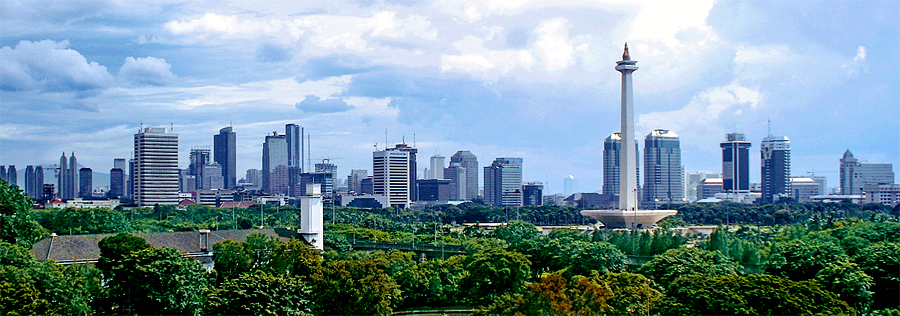
As Indonesia’s capital city, most foreign diplomatic missions reside in Jakarta. Most of the embassies are situated in the Menteng area and M.H. Thamrin Avenue in Central Jakarta, and also Jalan Jenderal Sudirman, Kuningan and Mega Kuningan area in South Jakarta. Apart from Jakarta, a number of consulates are also situated in other major cities of Indonesia, most preferably Bali as one of Indonesia’s favorite tourist destinations.
1. FOREIGN EMBASSIES IN JAKARTA
1. Afghanistan Embassy
Jl. Dr. Kusumaatmaja SH No. 15
(P.O. Box 1100 JKP 10011)
Menteng, Jakarta Pusat 10310
Phone: (62-21) 314-3169
Fax: (62-21) 3193-5390
Email: afghanembassy_indo@yahoo.com
2. Algerian Embassy
Jl. H. R. Rasuna Said Kav. 10-11
Kuningan, Jakarta Selatan 12950
Phone : (62-21) 525-4719, 525-4809
Fax: (62-21) 525-4654
Email: ambaljak@cbn.net.id
3. Argentine Embassy
Menara Thamrin, Jl. M.H. Thamrin Kav. 3
17th floor, Suite 1705, Jakarta 10250
Phone: (62-21) 230-3061, 230-3761
Consular Phone: (62-21) 3190-8572
Fax (62-31) 230-3962
Email eisia@mrecic.gov.ar
Consular Email consulares_eisia@mrecic.gov.ar
Website eisia.cancilleria.gov.ar
4. Armenian Embassy
Jl. Denpasar II, no 49
Kuningan, South Jakarta 12950
Phone: (62-21) 527-6549
Fax: (62-21) 2967-5166
Email: armindonesiaembassy@mfa.am
Website: www.mfa.am/
5. Australian
Jl. Patra Kuningan Raya Kav. 1-4
Jakarta Selatan 12950
Phone: (62-21) 2550-5555
Fax: (62-21) 2922-6775
Email: public-affairs-jakt@dfat.gov.au
Website: www.indonesia.embassy.gov.au
6. Austrian Embassy
Jl. Diponegoro No. 44
Menteng, Jakarta Pusat 10310
Phone: (62-21) 2355-4005
Fax: (62-21) 3190-4881
Email: jakarta-ob@bmeia.gv.at
Website: www.bmeia.gv.at
7. Azerbaijan Embassy
Jl. Mas Putih Blok D Persil 29
Grogol Utara, Kebayoran Lama
Jakarta Selatan 12430
Phone: (62-21) 2555-4408
Fax: (62-21) 2555-4409
Email: jakarta@mission.mfa.gov.az
Website: www.jakarta.mfa.gov.az
8. Bahraini Embassy
Jl. Patra Kuningan X, No. 1 B
Kuningan Timur Jakarta Selatan
Jakarta, 12950
Phone: (+62) 21 2902 1810
Fax: (+62) 21 2902 1811
9. Bangladesh Embassy
Jl. Karang Asem Utara Blok C4, No-12, Kav 42
Kuningan, Jakarta Selatan 12950
Phone: (62-21) 526-2173
Fax: (62-21) 526-2174
Email: bdootjak@yahoo.com
Website: www.bdembassyjakarta.org
10. Belarus Embassy
Jl. Patra Kuningan VII, No. 3
Kuningan, South Jakarta 12950
Phone: (62-21) 525-1388, 525-6256
Fax: (62-21) 5296-0207
11. Belgium Embassy
Deutsche Bank Building, 16th floor
Jl. Imam Bonjol No. 80
Menteng, Jakarta Pusat 10310
Phone: (62-21) 316-2030
Fax: (62-21) 316-2035
Email: jakarta@diplobel.fed.be
Website: diplomatie.belgium.be/indonesia
12. Bosnia and Herzegovina
Jl. HR Rasuna Said Kav 1 Guntur
Setiabudi, Jakarta Selatan 12980
Phone: (62-21) 8370-3022, 8370-3029
Fax: (62-21) 8370-3029
Website: www.paisesbalcanes.info/bosnia-y-herzegovina/
13. Brazil Embassy
Menara Mulia Building, 16th floor
Jl. Jend. Gatot Subroto Kav. 9-11
Jakarta Selatan 12930
Phone: (62-21) 526-5656, 526-5657, 526-5658
Fax: (62-21) 526-5659
Email: brasemb.jacarta@itamaraty.gov.br (general)
Email: consular.jacarta@itamaraty.gov.br
Website: jacarta.itamaraty.gov.br
14. Brunei Darussalam Embassy
Jl. Teuku Umar No. 51
Menteng, Jakarta 10350
Phone: (62-21) 3190-6080
Fax: (62-21) 3190 5070, 3190-5313
Email: jakarta.indonesia@mfa.gov.bn, kedubesbrunei@gmail.com
15. Bulgarian Embassy
Jl. Imam Bonjol No. 34-36
Menteng, Jakarta Pusat 10310
Phone: (62-21) 390-4048, 391-3130
Fax: (62-21) 390-4049
Email: bgemb.jkt@centrin.net.id, Embassy.Jakarta@mfa.bg
Website: www.mfa.bg
16. Cambodian Embassy
Jl. Pejaten Barat No. 41
Jakarta Selatan 12520
Phone: (62-21) 781 2523
Fax: (62-21) 781 2524
17. Canadian Embassy
World Trade Centre I, 6th Floor
Jl. Jend. Sudirman, Kav. 29-31
Jakarta 12920
P.O. Box 8324/JKS.MP, Jakarta 12084
Phone: (62-21) 2550-7800
Fax: (62-21) 2550-7811
Email: canadianembassy.jkrta@international.gc.ca
Website: www.canadainternational.gc.ca
18. Chile Embassy
The City Tower Building (TCT), 27th floor
Jl M.H. Thamrin No. 81
Central Jakarta 10310
Phone: (62-21) 3199-7201, 3199-7202
Fax: (62-21) 3199-7204
Website: chile.gob.cl/indonesia
19. People's Republic of China Embassy
Jl. Mega Kuningan No. 2
Karet Kuningan, South Jakarta 12950
Phone: (62-21) 576-1039
Fax: (62-21) 576-1037, 576-1038
Email: chinaemb_id@mfa.gov.cn
Website: id.china-embassy.org
20. Colombia Embassy
Sentral Plaza Building, 12th Floor
Jl. Jend. Sudirman Kav. 47
South Jakarta 12920
Phone: (62-21) 5790-3560
Fax: (62-21) 5290-5217
Email: eindonesia@cancilleria.gov.co
Website: indonesia.embajada.gov.co
21. Costa Rican Embassy
Wisma Keiai 7th floor, Suite 706
Jalan Jenderal Sudirman Kav. 3
Phone : (62-21) 572-3165
Fax: (62-21) 572-3166
Embcar-id@rree.go.cr
22. Croatian Embassy
Menara Mulia Building, 28th floor, Suite 2801
Jl. Jend. Gatot Subroto Kav. 9-11
Jakarta 12930
Phone: (62-21) 525-7822, 525-7611
Fax: (62-21) 520-4073
Email: jakarta@mvep.hr
Website: id.mvep.hr
23. Cuban Embassy
Jl. Logam Blok D No. 58
Permata Hijau, Jakarta 12210
Phone: (62-21) 548-5902
Fax: (62-21) 532-8174
Email: cubaindo@cbn.net.id, cubaindo@cbn.net.id
Website: www.cubadiplomatica.cu
24. Cyprus Embassy
Menara Sudirman 7th Floor B
Jl. Jendral Sudirman KAV 60
Senayan, Kebayoran Baru, South Jakarta 12190
Phone: (62-21) 5226-83739
Fax: (62-21) 522-6829
Email: hdh@cbn.net.id, cyprus.consulate@gmail.com
Website: www.mfa.gov.cy
25. Czech Republic Embassy
Jl. Gereja Theresia No. 20
Menteng, Central Jakarta 10350
Phone: (62-21) 239-6112, 239-6113
Fax: (62-21) 390-4078
Email: jakarta@embassy.mzv.cz
Website: www.mzv.cz/jakarta
26. Royal Danish Embassy
Menara Rajawali, 25th Floor
Jl. Mega Kuningan Lot 5.1
Kawasan Mega Kuningan, Jakarta 12950
(P.O. Box 4459)
Phone: (62-21) 576-1478
Fax: (62-21) 576-1535
Email: jktamb@um.dk
Website: www.indonesien.um.dk
27. Ecuador Embassy
World Trade Center I, 16th Floor
Jl. Jend. Sudirman Kav. 29-31
Jakarta 12920
Phone: (62-21) 522-6953, 521-1484
Fax: (62-21) 522-6954
Email: ecuadorindonesia@gmail.com, eecuindonesia@mmrree.gob.ec
Website: indonesia.embajada.gob.ec
28. The Arab Republic of Egypt Embassy
Jl. Teuku Umar No. 68
Menteng, Jakarta Pusat 10310
Phone: (62-21) 314-3440, 3193-1141, 3193-5350
Fax: (62-21) 314-5073
Email: jakarta_emb@mfa.gov.eg,
Website: www.mfa.gov.eg
29. Ethiopian Embassy
Jalan Aditiawarman No. 21
Selong, Kebayoran Baru, Jakarta Selatan 12110
Phone: (62-21) 2277-6658, 2277-6685
Fax: (62-21) 7278-9363
Email: ethembjakarta@gmail.com
30. Fiji Embassy
Sona Topas Tower, floor 5A
Jl. Jenderal Sudirman No. 26
South Jakarta 12920
Phone: (62-21) 250-6587
Fax; (62-21) 2941-0468
Email: info@fijiembajak.com
Website: www.fijiembajak.com
31. Finland Embassy
Menara Rajawali, 9th floor
Jl. Dr Ide Anak Agung Gde Agung, Lot No. 5.1
Kawasan Mega Kuningan, Jakarta 12950
Phone: (62-21) 2939-3000
Fax: (62-21) 576-1631
Email: sanomat.jak@formin.fi
Website: www.finland.or.id
32. France Embassy
Jl.MH. Thamrin No. 20
Jakarta Pusat 10310
Phone: (62-21) 2355-7600
Fax: (62-21) 2355-7601
Website: www.ambafrance-id.org
33. Georgia Embassy
Jl. Karangasem Tengah Blok C5 No.22
Kuningan, South Jakarta 12950
Phone: (62-21) 2941 0842
Fax: (62-21) 2941 0694
34. Germany Embassy
Jl. M.H. Thamrin No. 1
Menteng, Jakarta Pusat 10310
Phone: (62-21) 3985-5000
Fax: (62-21) 3985-5130
Email: germany@rad.net.id
Website: www.jakarta.diplo.de
35. The Hellenic Republic (Greece) Embassy
Plaza 89, Suite 1203, 12th Fl.
Jl. HR. Rasuna Said Kav. X-7 No. 6
Jakarta 12940
Phone: (62-21) 520-7776, 520-7761 (Embassy)
Phone: (62-21) 520-2471 (Consular)
Fax: (62-21) 520-7753
Email: gremb.jrt@mfa.gr (Embassy)
Email: grcon.jrt@mfa.gr (Consular)
Website: www.mfa.gr
36. Hungary Embassy
Jl. H.R. Rasuna Said Kav. X-3
Kuningan, Jakarta Selatan 12950
Phone: (62-21) 520-3459, 520-3460
Fax: (62-21) 520-3461
Email: huembjkt@rad.net.id
Website: jakarta.mfa.gov.hu
37. Indian Embassy
Jl. H.R. Rasuna Said Kav. S-1
Kuningan, Jakarta Selatan 12950
Phone: (62-21) 520-4150, 520-4152, 520-4157
Fax: (62-21) 520-4160
Email: info.india.jakarta@gmail.com
Website: www.indianembassyjakarta.com
38. Iran Embassy
Jl. H.O.S. Cokroaminoto No. 110
Menteng, Jakarta Pusat 10310
Phone: (62-21) 331-378, 331-391, 334-637
Fax: (62-21) 310-7860
Email: iranemb.jkt@mfa.gov.ir
Website www.jakarta.mfa.ir
39. Iraq Embassy
Jl. Teuku Umar No. 38
Menteng, Jakarta Pusat 10350
Phone: (62-21) 390-4067, 390-4068, 390-4069
Mobile: 0812-9078918
Fax: (62-21) 390-4066
Email: iraqembi@rad.net.id
Website: www.mofamission.gov.iq
40. Ireland Embassy
World Trade Center I, 14th Floor
Jl. Jend. Sudirman Kav. 29-31
Jakarta 12920
Phone: (62-21) 2809-4300
Fax: (62-21) 521-1622
Website: www.dfa.ie/indonesia
41. Italian Embassy
Jl. P. Diponegoro No. 45
Jakarta 10310
Phone: (62-21) 3193-7445 (operator)
Fax: (62-21) 3193-7422
Email: ambasciata.jakarta@esteri.it
Website: www.ambjakarta.esteri.it
42. Japan Embassy
Jl. M.H. Thamrin No. 24
Jakarta Pusat 10350
Phone: (62-21) 3192-4308
Fax: (62-21) 3192-5460
Website: www.id.emb-japan.go.jp
43. The Hashemite Kingdom of Jordan Embassy
Gedung Artha Graha, 9th floor
Jln Jend Sudirman Kav 52-53
Jakarta 12190
Phone: (62-21) 515-3483, 515-3484
Fax: (62-21) 515-3482
Email: jordanem@scbd.net.id
Website: www.jordanembassy.or.id
44. Kazakhstan Embassy
Jl. Denpasar Raya Blok A/12, Kav.1
Kuningan Timur, South Jakarta 12950
Phone: (62-21) 2944-0388
Fax: (62-21) 2944-0387
Email: jakarta.kaz@mail.ru
45. North Korean Embassy
Jl. Teluk Betung (Purworejo) Plot No. 1-2
P.O. Box 6190 MT
Jakarta 12050
Phone: (62-21) 3190-8425 / 3190-8426
Fax: (62-21) 3190-8445
Email: dprkorea@rad.net.id
46. South Korean Embassy
Jl. Jenderal Gatot Subroto Kav. 57 JKTM
P.O. Box 4187
Jakarta
Phone: (62-21) 2967-2555
Fax: (62-21) 2967-2556 / 7
Email: koremb_in@mofa.go.kr
Website: idn.mofat.go.kr
47. Kuwait Embassy
Jl. Mega Kuningan Barat 3 Kav 16-17
Kuningan, Jakarta Selatan
Phone: (62-21) 576-4556
Email ami@kuwait-toplist.com, kuwaitembassy_jkt@yahoo.com,kuwait_jkt@yahoo.com
48. The Lao People's Democratic Republic Embassy
Jl. Patra Kuningan XIV No. 1A
Kuningan, Jakarta Selatan 12950
Phone: (62-21) 522-9602, 522-7862
Fax: (62-21) 522-9601
Email: laoembjktof@hotmail.com
49. Lebanon Embassy
Jl. YBR V No. 82
Kuningan, Jakarta 12950
Phone: (62-21) 525-3074, 526-4306
Fax: (62-21) 520-7121
Email jakarta.leb@gmail.com
Website www.jakarta.mfa.gov.lb
50. People's Bureau of the Great Socialist People Libyan Arab Jamahiriya
Jl. Kintamani Raya II Blok C/17, Kav 6-7
Kuningan Timur, Jakarta Selatan 12950
Phone: (62-21) 5292-0033, 5292-0034, 5292-0035
Fax: (62-21) 5292-0036
51. Malaysian Embassy
Jl. H.R. Rasuna Said Kav. X-6 No. 1-3
Kuningan, Jakarta Selatan 12950
Phone: (62-21) 522-4947
Fax: (62-21) 522-4974
Website: www.kln.gov.my
52. Mali Embassy
Jl. Mendawai III No. 18
Kebayoran Baru, Jakarta 12130
Phone: (62-21) 720-8504, 720.8472
Fax: (62-21) 722-9589
53. Marshall Islands Embassy
Jl. Pangeran Jayakarta No. 115 Blok A 11
Jakarta Pusat 10730
Phone: (62-21) 624-9054
Fax: (62-21) 601-9759
54. México Embassy
Menara Mulia Building, 23rd floor, Suite 2306
Jl. Jend. Gatot Subroto Kav. 9-11
Jakarta Selatan 12930
Phone: (62-21) 520-3980
Fax: (62-21) 520-3978
Email: embmexico@gmail.com
Website: embamex.sre.gob.mx/indonesia
55. Mongolian Embassy
The East Tower 38th floor, Suite 3
Jl. Lingkar Mega Kuningan Blok E3.2 Kav. 1
Mega Kuningan, South Jakarta 12950
Phone: (62-21) 5795-8140
Fax: (62-21) 5795-8141
Email: contactus@mongolianconsulate.org, monembjkt@gmail.com
Website: www.mongolianconsulate.org
56. Morocco Embassy
Jl. Denpasar Raya No. 1
Kuningan, South Jakarta 12950
Phone: (62-21) 520-0773, 520-0956
Fax: (62-21) 520-0586
Email: sifamaind@gmail.com
57. Mozambique Embassy
Jl. Karang Asem II Blok C10 No. 2-3
Kuningan Timur, Setiabudi
Jakarta 12950
Phone: (62-21) 522-7955
Fax: (62-21) 522-7954
Email: consular.jkt@embamoc-indonesia.com
Website: www.embamoc-indonesia.com
58. Myanmar Embassy
Jl. H. Agus Salim No. 109
Menteng, Jakarta Pusat 10350
Phone: (62-21) 315-8908, 315-9095
Fax: (62-21) 316-0079
59. Royal Netherlands Embassy
Jl. H.R. Rasuna Said Kav. S-3
Kuningan, Jakarta Selatan 12950
(P.O.Box 2439 JKT 10024)
Phone: (62-21) 524-8200
Fax: (62-21) 570-0734
Email: jak@minbuza.nl
Website: www.netherlandsworldwide.nl
60. New Zealand Embassy
Sentral Senayan 2, Floor 10
Jl.Asia Afrika No. 8
Gelora Bung Karno, Jakarta Pusat 10270
Phone: (62-21) 2995-5800
Fax: (62-21) 5797-4578
Email: nzembjak@cbn.net.id
Website: www.mfat.govt.nz
61. Nigerian Embassy
Jl. Denpasar Raya Blok A. 13 No. 3
Kuningan Timur, 12950
Phone: (62-21) 526-0922, 526-0923, 326-686,340-4903
Fax: (62-21) 526-0924
Email: embnig@centrin.net.id
Website: www.nigerian-embassy.com/ng/Nigeria-in-Jakarta
62. Royal Norwegian Embassy
Menara Rajawali Building, 20th floor
Kawasan Mega Kuningan, Jakarta 12950
Phone: (62-21) 2965-0000
Fax: (62-21) 2965-0001
Email: emb.jakarta@mfa.no
Website: www.norway.no
63. The Sultanate of Oman Embassy
Jl. Latuharhari Raya No. 12
Menteng, Jakarta Pusat 10310
Phone: (62-21) 3190-8653, 3190-8654, 3190-8655
Fax: (62-21) 3190-8657
Email: omanreps@yahoo.com, jakarta@mofa.gov.om
64. Pakistan Embassy
Mega Kuningan Barat Kav 5-8, Blok E 3.9
Kuningan, Jakarta Selatan 12950
Phone: (62-21) 5785-1836, 5785-1837
Fax: (62-21) 5785-1645
Email: parepjakarta@mofa.gov.pk, pakembassyjakarta@gmail.com
Website: www.pakembjakarta.org
65. Palestine Embassy
Jl. Diponegoro No. 59
Menteng, Jakarta Pusat 10310
Phone: (62-21) 314-5444, 323-521, 310-6546, 323-521
Fax: (62-21) 310-8011
66. Panama Embassy
World Trade Center, 13th floor
Jl. Jend. Sudirman Kav. 29-31
Jakarta 12920
Phone: (62-21) 571-1867, 570-0218, 521-1821
Fax: (62-21) 571-1933
Email: embassy@panamaembassy.net
67. Papua New Guinea Embassy
Panin Bank Centre, 6th floor
Jl. Jend. Sudirman Kav. 1
Jakarta 10270
Phone: (62-21) 725-1218
Fax: (62-21) 720-1012
Email: kdujkt@cbn.net.id
Website: www.kundu-jakarta.com
68. Paraguay Embassy
Menara Anugrah
Jalan Mega Kuningan
Kantor Taman E3.3, Ground Floor, Unit C6
Jakarta, 12950
Phone: (62-21) 5795-0279
Fax: (62-21) 5795-0281
Email: indonesiaembaparsc@mre.gov.py, indopar2011@gmail.com
69. Peru Embassy
Menara Rajawali, 12th Floor
Jl. Dr. Ide Anak Agung Gde Agung
#Lot 5.1 Kawasan Mega Kuningan
Jakarta 12950
Phone: (62-21) 576-1820, 520-1821
Fax: (62-21) 520-1825
Email: embaperujak@gmail.com (general)
Email: conperjakarta@gmail.com (consular affairs)
Website: www.consulado.pe
70. Philippines Embassy
Jl. Imam Bonjol No. 6-8
Menteng, Jakarta Pusat 10310
Phone: (62-21) 310-0334
Fax: (62-21) 315-1167
Email jakartape@gmail.com
Website www.philembjkt.com
71. Poland Embassy
Jl. H.R. Rasuna Said Kav. X Blok IV3
Kuningan, Jakarta 12950
Phone: (62-21) 252-5938/9, 252-5940/42
Fax: (62-21) 252-5958
Email: plembjkt@rad.net.id
Website: www.dzakarta.msz.gov.pl
72. Portugal Embassy
Jl. Indramayu No. 2A
Menteng, Jakarta 10310 Indonesia
Phone: (62-21) 3190-8030
Fax: (62-21) 3190-8031
Email: jakarta@mne.pt
73. Qatar Embassy
Jl. Mega Kuningan E 2.3 No. 4
Kawasan Mega Kuningan, Jakarta Selatan
Phone: (62-21) 5790-6560, 5790-6561
Fax: (62-21) 5790-6564
Email: qataremj@rad.net.id, jakarta@mofa.gov.qa
Website: www.jakarta.embassy.qa
74. Romanian Embassy
Jl. Teuku Cik Ditiro No. 42A
Menteng, Jakarta Pusat 10310
Phone: (62-21) 390-0489, 310-6240
Fax: (62-21) 310-6241
Email: romind@indosat.net.id
Website: www.mae.ro
75. Russian Embassy
Jl. H. R. Rasuna Said Kav. X7 No. 1-2
Kuningan, Jakarta Selatan 12950
Tel. (62-21) 522-2912, 522-2914
Fax (62-21) 522-2916
Email rusemb.indonesia@mid.ru
Website www.indonesia.mid.ru
76. San Marino Embassy
Jl. Diponegoro No. 15 A
Menteng, Central Jakarta 10310
Phone: (62-21) 391-2918, 391-2891
Fax: (62-21) 391-2887
Webpage: www.esteri.sm
77. Kingdom of Saudi Arabia Embassy
Jl. MT Haryono Kav 27
Cawang , Jakarta Timur 13630
Phone: (62-21) 801-1533, 801-1535, 801-1537
Fax: (62-21) 800-5221
Email: idemb@mofa.gov.sa
Website: embassies.mofa.gov.sa
78. Serbian Embassy
Jl. H.O.S. Cokroaminoto No. 109
Menteng, Jakarta Pusat 10310
Phone: (62-21) 314-3560, 314-3720
Fax: (62-21) 314-3613
Email: embjakarta@serbian-embassy.org
Website: www.jakarta.mfa.gov.rs
79. Singapore Embassy
Jl. H.R. Rasuna Said Kav. X-4 No. 2
Kuningan, Jakarta Selatan 12950
Phone: (62-21) 2995-0400 (main)
Phone: (62-21) 0811-863348 (consular for Singapore nationals)
Fax: (62-21) 520-1486 (main)
Fax: (62-21) 520-2320 (consular)
Email: singemb_jkt@mfa.sg
Website: www.mfa.gov.sg
80. Slovakia Embassy
Jl. Prof. Mohammad Yamin SH No. 29
P. O. Box 1368
Menteng, Jakarta 10310
Phone: (62-21) 310-1068, 315-1429
Fax: (62-21) 310-1180
Email: emb.jakarta@mzv.sk
Website: www.mzv.sk
81. Somalian Embassy
Jl. Permata Hijau Raya Block T No. 8
Kebayoran Lama, Jakarta Selatan 12210
Phone: (62-21) 831-1506, 8379-5451
Fax: (62-21) 835-2586
Email: somalirep_jkt@yahoo.com, molow2000@yahoo.com
82. South African Embassy
Wisma GKBI, Suite 705
Jl. Jend. Sudirman Kav. 28
Jakarta Pusat 10210
Phone: (62-21) 2991-2500
Fax: (62-21) 574-0655
Email: molow2000@yahoo.com
Website: www.dirco.gov.za/jakarta/
83. Spain Embassy
Jl. H. Agus Salim No. 61
Gondangdia, Menteng, Jakarta Pusat 10350
Phone: (62-21) 314-2355, 3193-5940
Fax: (62-21) 3192-5996, 3193-5134
Website: www.exteriores.gob.es
84. Sri Lanka Embassy
Jl. Diponegoro No. 70
Menteng, Jakarta Pusat 10320
Phone: (62-21) 314-1018, 316-1886, 3190-2389
Fax: (62-21) 310-7962
Email: slembjkt@gmail.com
Website: www.srilankaembassyjakarta.com
85. Sudan Embassy
Wisma Bank Dharmala, 7th Floor
Jl. Jend. Sudirman Kav. 28
South Jakarta 12920
Phone: (62-21) 2902-3888
Fax: (62-21) 2902-3881
Email: sdn_indo@yahoo.com
86. Suriname Embassy
Jl. Dharmawangsa VIII No. 16
Kebayoran Baru, Jakarta Selatan 12160
Phone: (62-21) 2942-8523, 2942-8524/5
Fax: (62-21) 2942-8526
Email: embsurinamejakarta@gmail.com
87. Sweden Embassy
Menara Rajawali, 9th Floor
Jl. Dr. Ide Anak Agung Gde Agung No. 5.1
Mega Kuningan, Jakarta 12950
(PO Box 2824, Jakarta 10001)
Phone: (62-21) 2553-5900
Fax: (62-21) 2553-5941
Email: ambassaden.jakarta@gov.se
Website: www.abroad.se
88. Switzerland Embassy
Jl.H.R. Rasuna Said Blok X 3/2
Kuningan, Jakarta Selatan 12950
Phone: (62-21) 525-6061
Fax: (62-21) 520-2289
Email: jak.vertretung@eda.admin.ch
Website: www.eda.admin.ch/jakarta
89. The Syrian Arab Republic Embassy
Jl. Karang Asem I No. 8
Kuningan Raya, Jakarta Selatan 12950
Phone: (62-21) 520-4117, 520-1641, 525-5991
Fax: (62-21) 520-2511
Email: syrianemb@cbn.net.id
90. Royal Thai Embassy
JI. Dr Ide Anak Agung Gde Agung Kav. 3.3 (Lot 8.8)
Kawasan Mega Kuningan, Jakarta Indonesia 12950
Phone: (62-21) 2932-8190
Fax: (62-21) 2932-8199, 2932-8201
Email: thaijkt@biz.net.id
Website: www.thaiembassy.org
91. Timor Leste Embassy
Surya Building, 11th Floor
Jl. M.H. Thamrin Kav. 9
Jakarta Pusat, 10350
Phone: (62-21) 390-2678, 390-2679
Fax: (62-21) 390-2660
92. Tunisian Embasssy
Jl. Karang Asem Tengah Blok C5 No. 21
Kuningan, Jakarta Selatan 12950
Phone: (62-21) 5289-2328, 5289-2329
Fax: (62-21) 525-5889
Email: atjkt@uninet.net.id, tunjakarta@gmail.com
93. Turkey Embassy
Jl. H.R. Rasuna Said Kav. 1
Kuningan, Jakarta Selatan 12950
Phone: (62-21) 525-6250, 526-4143
Fax: (62-21) 522-6056
Email: embassy.jakarta@mfa.gov.tr
Website: jakarta.emb.mfa.gov.tr
94. Ukraine Embassy
Jl. Jend Sudirman Kav 29-31
Karet Setiabudi, Jakarta Selatan
Phone: (62-21) 250 08 01
Fax: (62-21) 250 08 02
Email: uaemabs@rad.net.id, emb_id@mfa.gov.ua
Website: indonesia.mfa.gov.ua
95. United Arab Emirates Embassy
Jl. Prof. Dr. Satrio Blok C-4, Kav. 16-17
Jakarta Selatan 12950
Phone: (62-21) 520-6518, 520-6528
Fax: (62-21) 520-6526
Email: uaeemb@rad.net.id, jakarta@mofa.gov.ae
96. Her Britannic Majesty's Embassy (United Kingdom)
Jl. Patra Kuningan Raya Blok L5-6
Jakarta 12950
Phone: (62) (21) 2356-5200
Fax: (62) (21) 2356-5351
Fax: (62) (21) 3983-5538 (Consulate)
Email: Jakarta.mcs@fco.gov.uk
Website: www.gov.uk
97. United States of America Embassy
Jl. Medan Merdeka Selatan No. 3-5
Jakarta Pusat 10110
Phone: (62-21) 3435-9000, 344-2211
Fax: (62-21) 386-2259
Email: jakconsul@state.gov, jakartaACS@state.gov (consular section)
Website: id.usembassy.gov
American Cultural Center
U.S. Commercial Center in Indonesia
www.export.gov/indonesia
98. Uzbekistan Embassy
Jln Daksa 3 No. 14
Kebayoran Baru, Jakarta Selatan
Phone: (62-21) 720-0950, 720-0972
Fax: (62-21) 720-0965
Email: inbox@uzbemb.or.id
Website: www.uzbemb.or.id
99. Apostolic Nuncio (Vatican)
Jl. Medan Merdeka Timur No. 18
(P.O. Box 4227, Jakarta)
Jakarta Pusat 10110
Phone: (62-21) 384-1142, 381-0736
Fax: (62-21) 384-1143
Email: vatjak@cbn.net.id
100. Venezuela Embassy
Menara Mulia, 20th floor, Suite 2005
Jl. Jend. Gatot Subroto Kav. 9-11
Jakarta Selatan 12930
Phone: (62-21) 5227-5489
Fax: (62-21) 522-7547
Email: embavenezindonesia@gmail.com
Website: www.venezuela.org.my
101. Vietnam Embassy
Jl. Teuku Umar No. 25
Menteng Jakarta Pusat 10350
Phone: (62-21) 910-0163, 310-0358
Fax: (62-21) 314-9615
Email: jakarta@mofa.gov.vn, vietnamemb@yahoo.com
102. Yemen Embassy
Jl. Subang No. 18
Menteng, Jakarta Pusat 10350
Phone: (62-21) 310-8029, 310-8035, 390-4074
Fax: (62-21) 390-4946
Email: yemb-jakarta@mofa.gov.ye, alsoswa@gmail.com
103. Zimbabwe Embassy
Jl. Patra Kuningan VII No. 15
Kuningan Timur, Setiabudi, Jakarta 12950
Phone: (62-21) 522-1378, 521-0485, 521-0486
Fax: (62-21) 525-0365
Email: zimjakarta@yahoo.com
2. FOREIGN REPRESENTATIVE IN JAKRATA
1. Albanian Honorary Consulate
Wisma 46, Kota BNI, 41st floor
J1. Jend Sudirman Kav. 1
Jakarta 10220
Phone: (62- 21) 570-1837, 812-8888 899
Fax: (62- 21) 574-6464
Email: fab8buddy@gmail.com
2. Gambia Honorary Consulate
Wisma Metropolitan I, 10th Floor
Jl. Jenderal Sudirman Kav. 29
Jakarta 12920
Phone: (62-21) 525-1641
Fax: (62-21) 520-7789
Email: congen.gambia@yahoo.com
3. Solomon Islands Consulate
Jl. Pangeran Antasari KH. Naim I/28
Kebayoran Baru, Jakarta Selatan 12150
Phone: (62-21) 726-4606
Fax: (62-21) 726-4607
3. FOREIGN REPRESENTATIVE IN BALI
1. Australian Consulate General
Jalan Tantular No. 32, Renon
Denpasar, Bali 80234
Phone: (0361) 200-0100
Fax: (0361) 2000195(DFAT)
Fax: (0361) 241-120 (Immigration)
Email: bali.congen@dfat.gov. au
Website: www.bali.indonesia.embassy.gov.au
2. Honorary Consulate of Brazil
Jl. Raya Legian No. 186
Kuta 80361 Bali
Phone: (62-361) 757-775
Fax: (62-361) 751-005
Email: renato@bythesea.co.id
3. Consulate of the Republic of Chile
Jl. Pengembak Gg1 No. 3
Sanur, Denpasar 80827
Phone: (0361) 756-781
Fax: (0361) 756-783
Email: chilehonconsulate@bali-villa.com
Website: chileabroad.gov.cl
4. Consulate General of the People's Republic of China
Jalan Tukad Badung 8X, Renon
Denpasar Selatan, Kota Denpasar, Bali 80226
Phone: (62-361) 239-901 (consular matters)
Phone: (62-361) 239-901, 239-902
Fax: (62-361) 239-001
Email: chinaconsul_dps_id@mfa.gov.cn
Wechat: Chinaconsul-Bali
Website: denpasar.china-consulate.org
5. Czech Honorary Consulate in Denpasar
Jl. Pengembak No. 17
Sanur, Bali 80228
Phone: (62-361) 286-465
Fax: (62-361) 286-408
Email: bali@honorary.mzv.cz
Website: www.mzv.cz/jakarta
6. Danish Honorary Consulate in Denpasar
Jl. By Pass Ngurah Rai No. 852
Pemogan, Denpasar, Bali 80221
Phone: (62-361) 821-6979
Fax: (0361) 766-638
Email: danishconsbali@gmail.com
Website: http://indonesien.um.dk
7. Estonian Honorary Consulate in Denpasar
Villa Prashanti
Jl. Jantuk Angsa No. 38
Banjar Kang-kang, Pererenan
Mengwi, Badung, Bali
Phone: (+62) 0811-987111
Fax: (62-361) 384-8156
Email: bharat@consul-estonia.or.id
Website: www.consul-estonia.or.id
8. Honorary Consulate of Finland
Segara Village Hotel
Jl. Segara Ayu, Sanur
Denpasar 80228
Phone: (62-361) 282-223
Fax: (62-361) 282-211
Email: finnishconsulatebali@yahoo.com
Website: www.finland.or.id
9. Consulate of France
Villa A Griya Alit
Jl. Umalas 1 No. 80
Kerobokan. Kuta 80117 Bali
Phone: (0361) 473-0834
Email: consul@dps.centrin.net.id
Website: id.ambafrance.org
10. Consulate of Germany
Mr Reinhold Jantzen
Jl. Pantai Karang 17
Batujimbar-Sanur, Denpasar
Phone: (62-361) 288-535
Fax: (62-361) 288-826
Email germanconsul@bali-ntb.com, sanur@hk-diplo.de
Website www.jakarta.diplo.de
11. Consulate of Hungary
Marintur Jl. Bypass Ngurah Rai No. 219
Sanur, Bali
Phone: (62-361) 287-701
Fax: (62-361) 287-456
Email: huconbali@gmail.com
Website: www.mfa.gov.hu
12. Consulate of India
Jl. Raya Puputan No. 163
Renon, Denpasar, Bali-80235
Phone: (62-361) 259-500, 259-502
Fax: (62-361) 222-253, 259-505
Email: info@cgibali.in, hoc.bali@mea.gov.in
Website: www.indianembassyjakarta.com
13. Consulate of Italy
c/o Gedung Lotus Asia Tour
Jl. Bypass Ngurah Rai Jimbaran
Jimbaran, Bali
Phone: (62-361) 701-005
Fax: (62-361) 701-005
Email: italconsbali@italconsbali.org
Website: www.italconsbali.org
14. Consulate of Japan
Jl. Raya Puputan No. 170
Renon, Bali (P.O. Box No. 3432)
Phone: (62-361) 227-628
Fax: (62-361) 265-066
Email: denpasar@dp.mofa.go.jp
Website: www.id.emb-japan.go.jp
15. Consulate of Malaysia
Alam Kulkul Boutique Resort
Jl. Pantai Kuta
Legian Bali 80030
Phone: (62-361) 752-520
Fax: (62-361) 752-519
16. Consulate of Mexico
c/o P. T. Astina Tours and Travel
Jl. Prof. Moh. Yamin No. 1A
(P.O. Box 3150)
Renon, Denpasar, Bali
Phone: (62-361) 223-266
Fax: (62-361) 244-568
Email: yudhara@astinatravel.com
Website: embamex.sre.gob.mx/indonesia/
17. Consulate of the Netherlands
Jl. Raya Kuta No. 127
Kuta, Denpasar 80361, Bali
Phone: (62-361) 761-502
Fax: (62-361) 754-897
Email: dutchconsulate@kcbtours.com
Website: indonesia.nlembassy.org
18. Consulate of New Zealand
Jl. Subaksari No. 10,
Banjar Tegal Gundul Tibu Beneng, Canggu
Phone: (0361) 844-6456
Email: indy.honcondibali@gmail.com
Website: www.mfat.govt.nz
19. Royal Norwegian Honorary Consulate
Segara Village Hotel
Jl. Segara Ayu, Sanur
Denpasar 80228
Phone: (62-361) 282-223
Fax: (62-361) 282-211
Email: norwegianconsulatebali@yahoo.com
Website: www.norway.or.id
20. Portuguese Honorary Consulate in Denpasar
Jl. Raya Sanggingan Banjar Lungsiakan Kedewatan
Ubud
Phone: (0361) 975-736
Fax: (0361) 975-726
Email: ariefocalifo@gmail.com
21. Russian Honorary Consulate
Perumahan Bali Kencana Resort
Block Merpati No. 10
Ungasan, Jimbaran 80364 Bali
Phone: (62-361) 279-1560
Fax: (62-361) 279-1561
Email: rusconsul@balivoyage.com
Website: www.indonesia.mid.ru
22. Slovakian Honorary Consulate
Jl. Gunung Agung No. 93
Denpasar 80118 Bali
Phone: (62-361) 900-5583
Fax: (62-361) 426-477
Email: konsulslowakbali@yahoo.com
Website: www.mzv.sk/jakarta
23. South African Honorary Consulate
Jl. By Pass Ngurah Rai 300B
Tuban 80361
Denpasar, Bali
Phone: (62-361) 751-223
Fax: (62-361) 761-896
Email: bagus.sudibya@bagus-discovery.com
Website: www.dirco.gov.za/jakarta/
24. Spanish Honorary Consulate
Jl. Raya Sanggingan
Banjar Lungsiakan Kedewatan, Ubud
(P.O. Box 39)
Bali 80571
Phone: (62-361) 975-736
Fax: (62-361) 975-726
Email: espana_bali@blueline.net.id, amir@rabik.co.id
Website: www.exteriores.gob.es
25. Consulate of Sri Lanka
Jl.Bypass Ngurah Rau No. 100
Pesanggaran, Denpasar 80222
Phone: (0361) 726-200
Fax: (0361) 726-271
26. Consulate of Switzerland & Austria
Jl. Ganetri No. 9D
Gatot Subroto Timur
Denpasar 80235, Bali
Phone: (62-361) 264-149
Fax: (62-361) 243-747
Email: bali@honrep.ch
Website: www.eda.admin.ch/jakarta
27. Consulate of Thailand
Jl. Pemuda 2 No. 9
Renon, Denpasar 80235
Phone: 0361-249461
Fax: 0361-249462
Email: rtcdps@yahoo.com
Website: www.thaiembassy.org/
28. Consulate General of the Democratic Republic of Timur Leste
Jl. Tukad Mas 1 No. 4
Renon, Bali
Phone: (0361) 235-093
Fax: (0361) 235-092
Email: cgtl@dpsbali.com
Website: timor-leste.gov.tl
29. Tunisian Honorary Consulate
Jl. Hayam Wuruk No. 159
Denpasar 80235 Bali
Phone: (62-361) 242-659
Fax: (62-361) 242-588
Email: tunisconsulbali@popodanes.org,popo@popodanes.com
30. Consulate of the United Kingdom
Jl. Tirta Nadi 2 No. 20
Sanur, Denpasar, Bali 80238
Phone: (62-361) 2356-5200
Fax: (62-361) 287-804
Email: consulate.bali@fco.gov.uk
Website: www.ukinindonesia.fco.gov.uk
31. Consular Agency of the USA
Jl. Hayam Wuruk No. 310
Denpasar 80235 Bali
Phone: (62-361) 233-605
Fax: (62-361) 222-426
Email: CABali@state.gov
Website:surabaya.usconsulate.gov

LOCAL LAWS
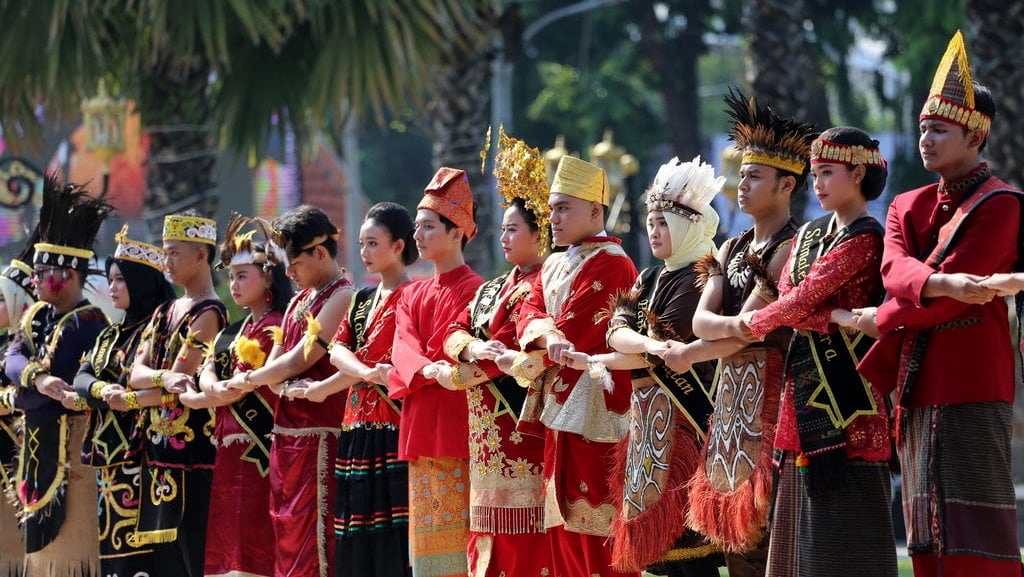
When visiting other countries, it is customary to pay close attention to the local laws that apply, Indonesia is no exception. As a country of diversity with an abundance of different cultures, laws, and customs to honour, respect and comply with, Travelers who plan to visit Indonesia must follow these local laws & customs to avoid any trouble or mishaps.
DRUGS
What is the penalty for drug possession and trafficking in Indonesia?
Like in many countries, Indonesia has Capital Punishments for Possession and Trafficking of illegal drugs.
Possession is punishable by 4 to 12 years of imprisonment and IDR. 800 million to IDR. 8 Billion (US$89,600 to US$896,000) worth of fines. If the drugs exceed 1 kilogram (for raw drugs like marijuana) or 5 grams (for processed drugs like heroin and cocaine), a maximum punishment of life imprisonment may be imposed.
Trafficking is punishable by 5 to 15 years of imprisonment and fines of IDR One Billion to Ten Billion (US$112,000 to US$1.2 million). If the volume of drugs exceeds 1 kilogram (for raw drugs) or 5 grams (for processed drugs), the death penalty may be imposed!
SMOKING
Is Smoking Allowed in Indonesia?
Smoking is prohibited in public places, such as Healthcare Facilities, Educational Facilities, and Places of Worship. Smoking is also prohibited in Public Transport. Children’s Outdoor or Indoor Facilities are also a smoke-free zone. Designated smoking areas are a must in other types of public places and office buildings.
How Many Cigarettes Can I Bring to Indonesia?
Travellers could bring a maximum of 200 cigarettes, 50 cigars or 100 grams of tobacco and a reasonable amount of perfume per adult.
DRINKING
Is alcohol legal in Indonesia?
As a country with Muslims as the majority, alcohol drinking is prohibited by the laws of the religion and frowned upon. However, since Indonesia is a country with diverse cultures and religions, currently there are no alcohol bans being enforced in Indonesia, with the exception of Aceh.
Drinking is also prohibited in most Public Places such as Worship Places, Workplaces, Schools, Malls, Supermarkets, Minimarkets, Outdoor/Indoor Public Space, and other places where there are a lot of people/crowd in the area. Also prohibited, driving while under the influence of alcohol. Don’t drink and drive!
What is the drinking age in Indonesia?
The legal age for drinking in Indonesia is 21 years old. Those who are caught drinking outside the legal age will face serious punishment or charges from the authorities.
OVERSTAYING
What Happens if I overstayed in Indonesia?
Indonesia’s law on immigration for overstayed Travellers is no more than 60 days. Those who overstay within the 60 days period will have to pay a daily fine of IDR up to IDR. 1 Million per day. Those who overstayed more than 60 days will face deportation and possible blacklisting.
DRIVING
Can Foreigners Drive in Indonesia?
Foreigners can drive using an international driving permit that has been issued in Indonesia, as well as a driver's license from the individual’s home country. Alternatively, foreigners can have the international driving permit issued in their home country before they leave, but this may need to be endorsed by the Indonesian licensing office in Jakarta once they arrive.
What is the Age Limit to Drive in Indonesia?
The age limit to drive in Indonesia after obtaining the Indonesian driving license issued by the Indonesian National Police (Polri) is 17 years old.
What is the speed limit in Indonesia?
In Indonesia, people drive on the left-hand side of the road, and standard international driving laws apply. The speed limit is 50kph in urban areas in Indonesia, and 100kph on a motorway, but the only proper motorways in the country are in Java.
GAMBLING
Is Gambling Legal in Indonesia?
Gambling is prohibited in Indonesia, it is considered completely illegal for both locals and foreigners. There are no proper casinos in the country, and those who practice gambling may find severe punishments by authorities and thrown to jail.

EMERGENCY HOTLINES
Indonesia has different systems for landlines and mobile phones: landlines use area codes, while mobile phones do not. For landline area codes, the digit "0" is added in front when dialling domestic long distance from within Indonesia, but is always omitted when calling from abroad. Here are some important numbers/hotline for Police Assistance in case you need assistance on a matter:
EMERGENCY NUMBERS
- Police/General Emergencies: 110 or 112 (From Satellite and Mobile Phones)
- Ambulance and Medical Emergencies: 118 or 119
- Firefighter: 113
- Search and Rescue (BASARNAS): 115
- Natural Disaster Assistance: 129
USEFUL NUMBERS
- International Phone Number Information: 102
- Local Phone Number Information: 108
- Domestic Call Operator: 100 and 106
- International Call Operators: 101 and 107
TOURISM INFORMATION
- Bureau of Public Communication of the Ministry of Tourism: +62 21 3838899
Important note for foreigners visiting Indonesia, be sure to carry your passport with you at all times as a form of identification as a precaution measures. Chances are you won't need it, but there is always a chance that you may be required to do so.

WHEATER, CLIMATE & SEASONS
What is the weather like in Indonesia?
The climate of Indonesia is almost entirely tropical. The uniformly warm waters that make up 81% of Indonesia's area ensures that temperatures on land remain fairly constant, with the coastal plains averaging 28 °C, the inland and mountain areas averaging 26 °C, and the higher mountain regions, 23 °C. Temperature varies little from season to season, and Indonesia experiences relatively little change in the length of daylight hours from one season to the next.
Is the weather generally rainy?
The main variable of Indonesia's climate is not temperature or air pressure, but rainfall. The area's relative humidity ranges between 70% and 90%. Although air temperature changes little from season to season or from one region to the next, cooler temperatures prevail at higher elevations. In general, temperatures drop approximately 1°C per 90-meter increase in elevation from sea level with some high-altitude interior mountain regions experiencing night frosts.
Are there different seasons in Indonesia?
Being a tropical country, Indonesia does not have spring, summer, autumn, or winter, instead of just the two seasons of Rainy and Dry, both of which are relative. While there is significant regional variation, in most of the country (including Java and Bali) the dry season is April to October, while the wet season is November to March. However, global warming has made the seasons less predictable.

TIME DIFFERENCES
All You Need to Know About Indonesia’s Time Zones
As a massive archipelago, it is understandable that Indonesia has different time zones in its territory. There is the Indonesia Western Standard Time (WIB), Indonesia Central Standard Time (WITA), and Indonesia Eastern Standard Time (WIT). So what are these time zones and how do you calculate the differences from all over the world?
What is Western Standard Time (WIB)?
The western side of Indonesia follows Western Standard Time, known as Waktu Indonesia Barat (WIB). The area covered here is the whole of Sumatra Island, the whole of Java Island, West Kalimantan province and also Central Kalimantan. So if you’re visiting cities like Jakarta, Bandung, Batam or Pontianak, adjust your watches to the time of WIB. Jakarta is also the capital of Indonesia, therefore it has become a benchmark for time differences all over the world.
What about Central Standard Time (WITA)?
Just an hour difference from WIB, the central part of Indonesia follows WITA. Adjust your watches accordingly to this time zone if you’re visiting cities in South Kalimantan, East Kalimantan, North Kalimantan, the whole of Sulawesi island, the whole of Bali Island, West Nusa Tenggara and East Nusa Tenggara (like Denpasar or Makassar).
How is the Eastern Standard Time (WIT)?
Visiting cities like Maluku or somewhere in Papua? Set your watches to the WIT time zone. It has a two-hour difference from WIB and applies to only Maluku and Papua (including North Maluku and West Papua).
Time Zones and Prayer Times in Indonesia
As a Muslim majority country, there is always a mosque nearby in every part of Indonesia that alerts the people with the call to prayer during the five prayer times. Prayer times all over the country differ due to the different time zones. The earliest prayer time is at 4 - 5 AM at sunrise, continued to another around noon, the next would be 3 PM in the afternoon, then 6 PM at dusk and finally 7 PM in the evening.
STAYING SAFELY
How do I make calls in Indonesia using a landline?
Telephone numbers in Indonesia have different systems for landlines and mobile phones: landlines use area codes, while mobile phones do not. For landline area codes, the digit "0" is added in front when dialing domestic long distance from within Indonesia, but is always omitted when calling from abroad. Instead, callers would use the Indonesian country code +62, followed by the area code, without the "0". To make a phone call to Indonesia from abroad via landlines, callers dial +62, followed by the area code and subscriber's number, omitting the ‘0’. For calls to mobile wireless phones (GSM) from abroad, callers dial +62, followed by the subscriber's number, omitting the '0'.
What are the main emergency numbers I need to know?
- Police/General Emergencies: 110 or 112 (From Satellite and Mobile Phones)
- Ambulance and Medical Emergencies: 118 or 119
- Firefighter: 113
- Search and Rescue (BASARNAS): 115
- Natural Disaster Assistance: 129
Useful Numbers:
- International Phone Number Information: 102
- Local Phone Number Information: 108
- Domestic Call Operator: 100 and 106
- International Call Operators: 101 and 107
Tourism Information:
- Bureau of Public Communication of the Ministry of Tourism: +62 21 3838899

BUSINESS HOURS & HOLIDAYS
Business Hours and Holidays in Indonesia
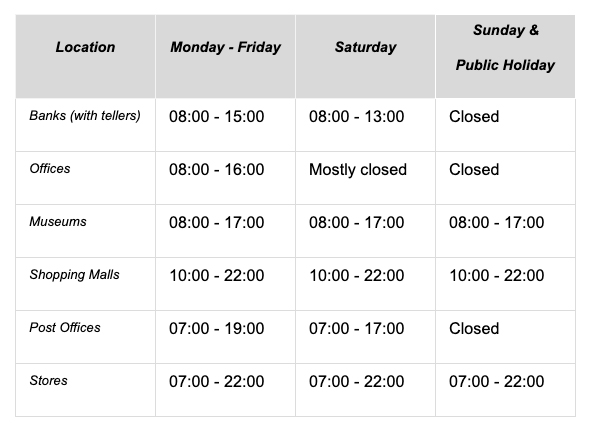
Even during our travels away from home, there will always be a need for post offices, banks, and shops. It might be a little confusing at first because the business hours might differ here. This rough guide to the standard business hours will help you out! Keep in mind that this is a rough estimation since different businesses have slightly different opening hours individually and in different areas. So be sure to check out their respective websites to make sure.
When does everything open?
The best time to continue on with your activities after 10 a.m since that is when most places open. There will always be restaurants and cafes that are 24 hours or open in the early mornings so you don’t have to worry about getting hungry.
What are the national public holidays in Indonesia?
There are a few public holidays in Indonesia where offices are on holiday and most stores don’t open as long. On national public holidays, most people decide to stay home and rest, but there is also a chance that malls and stores will be crowded, especially if it falls like a long weekend.
The national public in Indonesia starts with the New Year on the 1st of January. This holiday lasts for just one day. The next public holiday of the year would be Chinese New Year, celebrating the New Year of the Chinese Calendar. This holiday falls on either January or February.
On the 1st of May, Labor Day is a public holiday. Normally on this day workers go to the streets peacefully to ask for better work conditions and better wages. On the 1st of June, Indonesia celebrates the birth of the Pancasila, the country’s foundational philosophical theory.
Indonesia celebrates its Independence Day on the 17th of August. This is a very festive holiday because people gather together with their neighbors or their coworkers for unique games like races and friendly competition. A lot of people wear the colors of Indonesia’s flag: white and red. Join in all the fun!
How about the Religious Holidays Indonesia celebrates?
Indonesia recognizes a lot of religions and the holidays to celebrate important days of each one of them. As a Muslim majority country, the most celebrated holiday is Idul Fitri and Idul Adha. The dates differ and are observed based on the Islamic calendar. On Idul Fitri, the holidays normally would be extended for about 7 and up to 10 days of join-leave for a nationwide holiday. This is because extended families normally gather together in their hometowns.
It is also important to note that Indonesians celebrate Ramadhan where they fast from dawn to dusk. During this time, a lot of restaurants and food stalls close to respect the ones fasting. Most fast-food restaurants or big restaurants are still open, but the curtains are normally drawn as to not be visible from the outside for respect.
Collective leave is also decided for Christmas on the 25th of December, but with a shorter time than the collective leave during Idul Fitri. Sometimes businesses decide to announce the holidays until New Year’s.
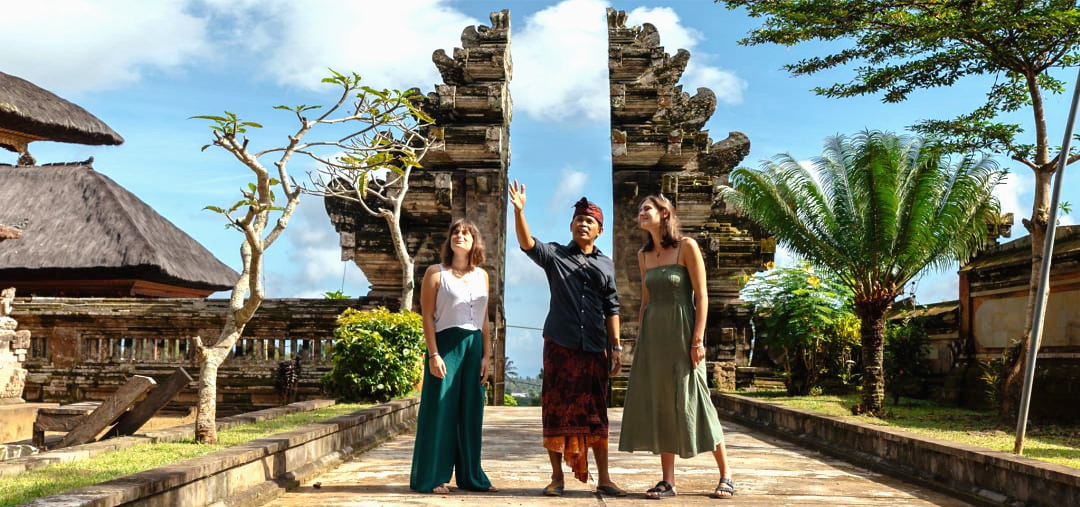
Another important holiday is the Day of Silence or Hari Raya Nyepi. It falls around March or April and is commemorated every Isakawarsa according to the Balinese calendar. It is a Hindu celebration that is mainly celebrated in Bali. It is specifically important for those of you who will be visiting Bali on this day because the airport along with the whole island will be closed off for 24 hours. The people will shut off electricity, not use their phones, not walk around or explore places and dedicate themselves to silence for one whole day. A very unique experience to see into the culture of Bali indeed.
Other public religious holidays:
- Good Friday falls on either March or April,
- Ascension of Jesus Christ normally around May or June,
- Day of Birth of Buddha also around May or June,
- The Islamic New Year differs according to the Islamic Calendar on the 1st Muharram. This past couple of years it has been around September and October,
- Birth of the Prophet falls on the 12th Rabi’al-awwal in the Islamic Calendar (Around October),
- The ascension of the Prophet is also a public holiday but differs based on the Islamic Calendar as well.
ACCOMMODATIONS
The Most Simplest One
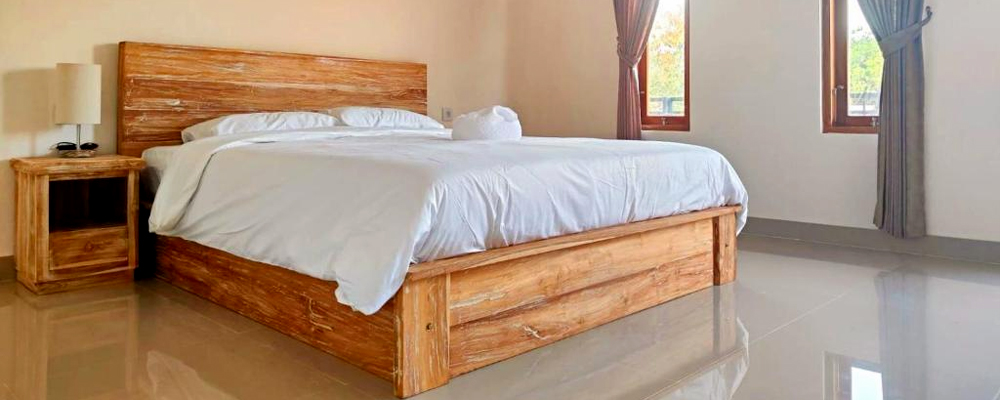
Prices for the simplest double room start at unbelievably cheap; around US$10.00, and in all categories are at their most expensive from mid-June through August, and in December and January. Single rooms are a rarity, so lone travelers will be put in a double at about 75% of the full price. Check-out time is usually noon (12:00-14:00). The cheapest accommodation has shared bathrooms, where you wash using a sharing "kamar mandi". Toilets in these places will be squat affairs, flushed manually with water scooped from the pail that stands alongside, so you’ll have to provide toilet paper yourself.
The bottom end of Indonesia’s accommodation market is provided by homestays and hostels. Penginapan, or homestays, are most often simply spare bedrooms in the family home, though there’s often not much difference between these and losmen, pondok and wisma, which are also family-run operations. Rooms vary from whitewashed concrete cubes to artful bamboo structures – some are even set in their own walled gardens. Hard beds and bolsters are the norm, and you may be provided with a light blanket. Most losmen rooms have fans and cold-water bathrooms.
Almost any place calling itself a hotel in Indonesia will include at least a basic breakfast in the price of a room. Most of the middle and top-end places add a service-and-tax surcharge of between 10% and 21% to your bill, and upmarket establishments quote prices – and prefer foreigners to pay – in dollars, though they accept plastic or a rupiah equivalent.
In popular areas such as Bali and Tanah Toraja, it’s worth booking ahead during the peak seasons. Bland and anonymous, cheap urban hotels are designed for local businesspeople rather than tourists, and have tiny rooms and shared squat toilets and kamar mandi. Moderately priced hotels often have a choice of fan or air-conditioned rooms, almost certainly with hot water.
In rural Indonesia, you may end up staying in villages without formal lodgings, in a bed in a family house. First ask permission from the local police or the kepala desa (village head). In exchange for accommodation and meals, you should offer cash or useful gifts, such as rice, salt, cigarettes or food, to the value of about US$2 at the very least. The only bathroom might be the nearest river. With such readily available and inexpensive alternatives, camping is only necessary when trekking.
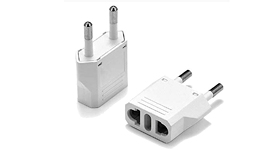
Usually, electricity is supplied at 220–240 volts AC, but outlying areas may still use 110 volts. Most outlets take plugs with two rounded pins. [Source]
INDONESIA AVERAGE HOTEL COSTS
Nightly Room Prices by Accommodation Type
Our detailed analysis of the prices of amazing hotels in Indonesia can help you understand how much you might need to spend for your next great trip. Whether you're on a budget or traveling in luxury, or by your self or with your family, we have tabulated the costs of hotels in Indonesia by category, star-rating, amenities, and guest reviews. Read on to find out if the best hotels in Indonesia are expensive, or where the best and cheapest hotels are located.
How much do hotels cost in Indonesia?
After analyzing 6,976 great hotels in Indonesia, we found the average hotel price in Indonesia is a remarkably economical $49, and the median price is $26. Naturally, the cities has many fantastic accommodation options with a variety of prices. The price of accommodation can vary by the hotel's amenities, available dates, and the general neighborhood.

The average hotel cost for one week in Indonesia is a surprisingly affordable $341, and the average hotel cost for two weeks in Indonesia is a surprisingly affordable $682 (not including taxes and fees).
How much should I pay to stay in a hotel in Indonesia?
You'll find the budget, mid-range, and luxury Indonesia hotel cost per night displayed below. This chart shows the range of hotel prices for a one night stay in Indonesia. If you're trying to figure out how much you should pay for a reservation, this graph breaks down the costs by price range.
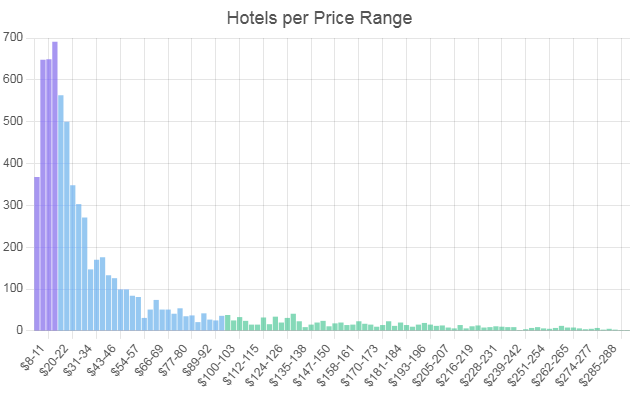
(All hotel prices are in US Dollars before taxes, and come from a base price that is reported by Kayak. Peak season prices can vary significantly, particularly in destinations where seasonal travel fluctuates dramatically.)
Are Hotels in Indonesia Expensive?
From the chart above, and from our statistical calculations, we can see that the average price for all hotels in Indonesia is $49. Also, the average price for budget hotels in Indonesia is $15. Furthermore, the average price for luxury hotels in Indonesia is $172. So, is a Indonesia expensive? Given the overall cost of living and travel in the area, these prices are not unreasonable. And if you think it's expensive to spend the night in Indonesia, don't worry, as it's quite possible to find hotel rooms with great values for your next trip. We have recommended hotels at various price ranges below.
PRICES FOR THE BEST HOTELS IN INDONESIA
Indonesia's Top Rated Hotels by Guests
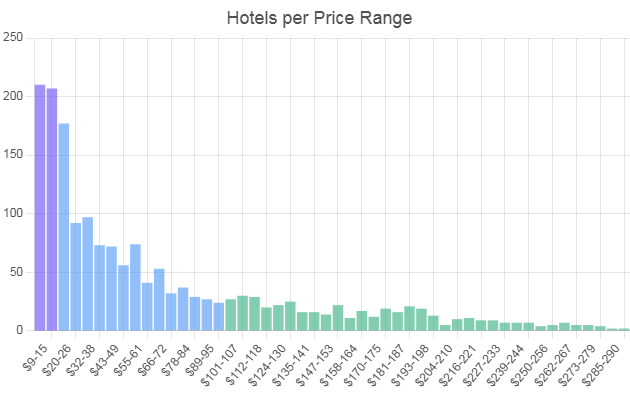
Are you looking for the best hotel in Indonesia? After we analyzed the 1,749 best and highest rated hotels (the top 25%), we found a variety of amazing options at different price ranges. The average price of the highest rated hotels is a great value at $71, and the median price is $45. So, here are the price ranges of the best places to stay in Indonesia for your next fantastic trip to this amazing destination.
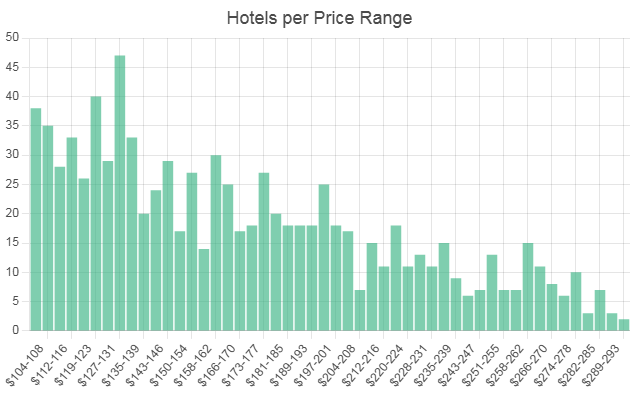
Prices for the Best Luxury Hotels in Indonesia
Looking for Indonesia's best hotels? We'll show you just how expensive hotels are in Indonesia. The average price of the 906 top luxury hotels in Indonesia is $172, and the median price is $164. The price ranges below will help you understand how much these fantastic hotels will cost for your next amazing trip.
How much should I pay to stay in a luxury hotel in Indonesia?
The chart below shows the range of the fantastic luxury hotel prices for a one night stay in Indonesia. If you're trying to figure out how much you should pay for a luxury reservation, this graph tabulates the costs of these terrific hotels by price range. These luxury hotels often include some of Indonesia's best boutique hotels and resorts.
Prices for Mid-Range Hotels in Indonesia
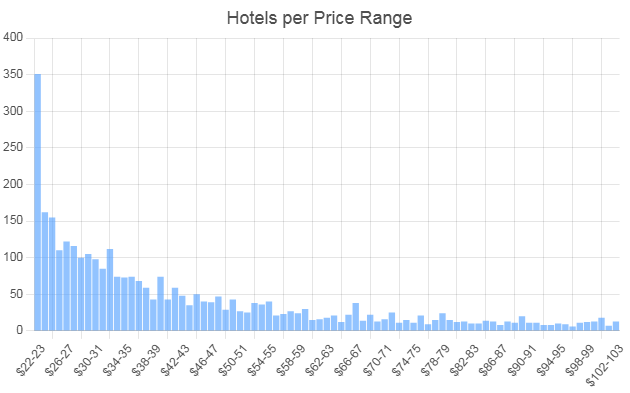
Hotel costs per night in Indonesia are displayed below for mid-range hotels. For the 3,319 mid-range hotels in Indonesia, the average price is $43, and the median price is $35. These typical Indonesia hotel rooms are a good representation of what is available, because they are in the middle of the total price range while still providing quality amenities.
How much should I pay to stay in a typical mid-range hotel in Indonesia?
The chart below shows the range of very nice moderately priced hotels for a one night stay in Indonesia. If you're trying to figure out how much you should pay for a booking, this graph tabulates the costs of these great accommodation options by price range. These hotels also include some of Indonesia's best bed & breakfasts and vacation rentals.
Prices for Budget Hotels in Indonesia
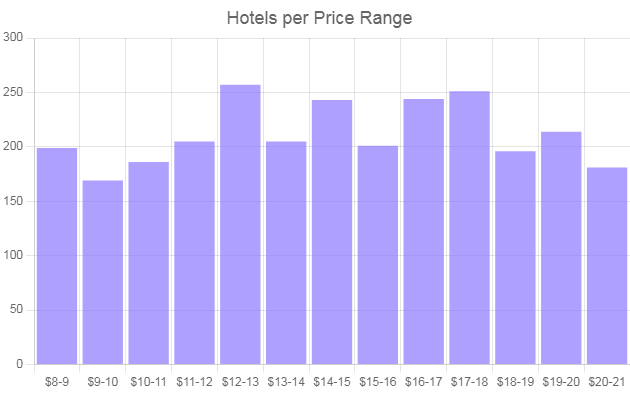
To find the best cheap hotels in Indonesia, we analyzed the prices of this destination's 2,751 budget hotels. The average price of these budget hotels is $15, and the median price is $15. The highest rated hotels which are below the average cost are presented below, along with the price ranges of all budget hotels. Now we'll show you just how affordable hotels can be in Indonesia, as the chart below shows the cheapest places to stay in Indonesia.
How much should I pay to stay in a budget hotel in Indonesia?
The chart below shows the range of the terrific budget-friendly hotel prices for a one night stay in Indonesia. If you're trying to figure out how much you should pay for a cheap hotel, this graph tabulates the prices of the great hotels here by range. These surprisingly affordable hotels often include some of Indonesia's best hostels and budget guesthouses, too. [
Source]

ACCOMMODATION IN INDONESIA
Statistics & Facts
Indonesia is a magnet for tourists due to its stunning natural beauty and fascinating cultural heritage. Domestic and international tourists traveling to all corners of the country not only spur the growth of the
travel and tourism industry but also become a major driver for Indonesia’s accommodation industry. In 2021, preliminary figures showed that the
gross domestic product (GDP) of the accommodation industry in Indonesia amounted to approximately 79.17 trillion Indonesian rupiah. This was an increase of around five trillion Indonesian rupiah compared to the previous year.
How is the current state of the Indonesian accommodation industry?
The accommodation industry in Indonesia is growing in response to the increasing flow of tourists arriving and staying in accommodation facilities. The industry was severely impacted by the coronavirus (COVID-19) pandemic as the government imposed social and border restrictions to mitigate the impact of the pandemic. Many
hotels and similar establishments were forced out of business, resulting in a decline of around one hundred such establishments in 2021.

After reopening the borders and removing all quarantine requirements, as well as scraping on-arrival COVID-19 testing for international inbound travelers, accommodation in Indonesia started to recuperate. The country saw an increase in hotel room occupancy rates, crawling back to pre-pandemic levels. In 2022, the occupancy rate of star-rated hotels in Indonesia continued to increase from September to December, with an occupancy rate of more than fifty percent. Similarly, the occupancy rates of non-star hotels have been rising after plunging during the pandemic.
Why is the hotel industry important in Indonesia?
The hotel industry represents the biggest segment of the Indonesian accommodation industry, with yearly revenues reaching billions of U.S. dollars in the last decades. After plummeting during the heat of the COVID-19 pandemic, Indonesia's hotel industry experienced a rapid rebound, reaching revenues close to pre-pandemic figures in 2021. The
revenue of the hotel industry in Indonesia is expected to continue to rise and reach 5.6 billion U.S. dollars by 2027.

Indonesians are getting back into traveling
After travel restrictions put the brakes on their travel plans,
many Indonesians are now ready to splurge on travel, lodging, and vacation. A recent study revealed that Traveloka was the go-to online travel agency among Indonesian travelers as of December 2022. Meanwhile, Tiket.com came in second as the most preferred online travel agency. The availability of promotional offers and discounts was the
top reason for using online travel agencies among Indonesian consumers in 2022. Some other reasons in favor of online travel agencies include the ease of use of the apps or website page and the lower prices offered. [
Source]

This text provides general information. Statista assumes no liability for the information given being complete or correct. Due to varying update cycles, statistics can display more up-to-date data than referenced in the text.

PLUGS AND ELECTRICITY
Charging your phone, laptop and other important gadgets is essential, especially during the trips. As for your trip in Indonesia, it is good to understand that plugs and electricity might be differ from the one back home. So what do you need in Indonesia then? An adapter? A voltage converter? Or maybe both? Let's check the following advice.
How is the standard voltage and electricity in Indonesia?
The standard voltage throughout Indonesia is normally 230 V and with a standard frequency of 50 Hz. If you’re from the UK, Europe, Australia and most of Asia or Africa countries, your devices and other gadgets could be charged like normal.
However, if you come from other countries such as the United States, Canada, and most of South American countries, the range of voltage differs here in Indonesia.
Charging it like normal is possible, but only for a short time and with a few risks. So you should consider buying a voltage converter instead, which is also available on Amazon or electrical stores all over Indonesia.
How does the power plugs in Indonesia differ from my country?
Most power plugs and sockets in Indonesia are type C and F. These plugs are the 2 pin socket and plug design which follow the standard of European plugs. If you’re coming from a country that does not use these type of sockets, you should buy an adapter. Amazon sells plenty, but you can also find them in many local mini-markets around Indonesia.
Where can I charge my gadgets in Indonesia?
You can find a socket in almost all restaurants in Indonesia, especially at the tourist attraction area. All hotels and airports have sockets and plugs that you can use for free as well. In trains, a plug is provided at all seats for all classes (economy and business) and in most shuttles transportation you can plug in a USB cable to charge your devices.

WIFI AND CONNECTIVITY
In this digital era, staying connected is an everyday need, anytime, anywhere. Whether it’s for business-related matters, keeping in touch with loved ones, updates in current issues or traveling pleasures, having an accessible online connection is a necessity. In Indonesia, the WiFi connection is available in many major public areas. Here is some useful info on WiFi accessibility throughout public spaces in Indonesia.
Do Indonesian Airports have WiFi Connections?
Soekarno–Hatta International Airport is the primary airport serving the Jakarta metropolitan area on the island of Java in Indonesia. As reported by the Jakarta Post, the airport has recently made WiFi accessible for all visitors in Terminal 1 and Terminal 2 of the airport with the WiFi Corner facility. This WiFi Corner is provided in cooperation with state-owned telecommunications company PT. Telkom.
Most International airports in Indonesia provide WiFi connection. For information on WiFi connections in other airports, contact the local information desk at the airport once you arrived.
Do Indonesian Hotels have Free WiFi?
Most major hotels in Indonesian have free WiFi connection for their guests and normally protected by passwords. Hotel guests will get the password info when checking in the hotel. For smaller hotels in small towns, WiFi connections are also commonly provided, but to be sure, you should check ahead prior to booking.
Do Indonesian Train Stations have Free WiFi?
There are currently facilities that support WiFi in a few stations in Indonesia’s capital city, Jakarta. However, PT. KAI, Indonesia’s state-owned train company announced in 2018 that they plan to provide free internet connection installed on all trains gradually.
In February 2019, PT. Kereta Commuter Indonesia (KCI), the local public transportation in Jakarta’s commuter line, has launched free WiFi for passengers in stations and on its trains in the Jakarta-Bogor-Depok-Tangerang-Bekasi area. The service is available at 46 stations in Jakarta and followed by 37 stations in Greater Jakarta in March.
PT KAI will also expand the service to trains and stations outside Greater Jakarta, such as the Argo Parahyangan train with the Gambir – Bandung route.
Where Can I Find Free WiFi in Indonesian Cities Public Areas?
Most public places in Indonesia’s major cities have Free Hot Spots for WiFi such as malls, restaurants, café’s, tourist attractions, etc. However in public areas, they are not always secured networks, so you might want to be really careful and read the terms and conditions more thoroughly before signing in.
How Can I Stay Connected All the Time in Indonesia?
If finding a Free Hot-spot for WiFi is less practical for you, you might want to opt for a Pocket WiFi Rental. By doing so you can rest assure to stay connected anywhere at anytime. There are plenty of rentals to choose from the net, where you can order the pocket size portable WiFi online, and have the device mailed to you or arrange a pick up when you arrived in your Indonesian city destination.
Keeping in touch with the outside world is rarely a problem in Indonesia as mobile phones are a common thing that almost everyone owns. To get a local SIM card during your stay in Indonesia is a more economical and practical option.
How to Get a Local SIM Card?
You could find SIM Card in airports where they held a number of local cell phone company providers booths for you to choose from such as Telkomsel, XL, Smartfren, 3/Tri, Axis, Indosat/IM3, etc. The prices vary for each provider but mostly starting from IDR 10,000.
How to Register an Indonesian SIM Card?
Foreigners will need either their Passport, or KITAS, or KITAP (the last two is for visitors with a long term stay) to register the local SIM Card. The officer in the provider’s booth will guide you through the registration process for your SIM card.
CREDIT CARDS AND CURRENCY
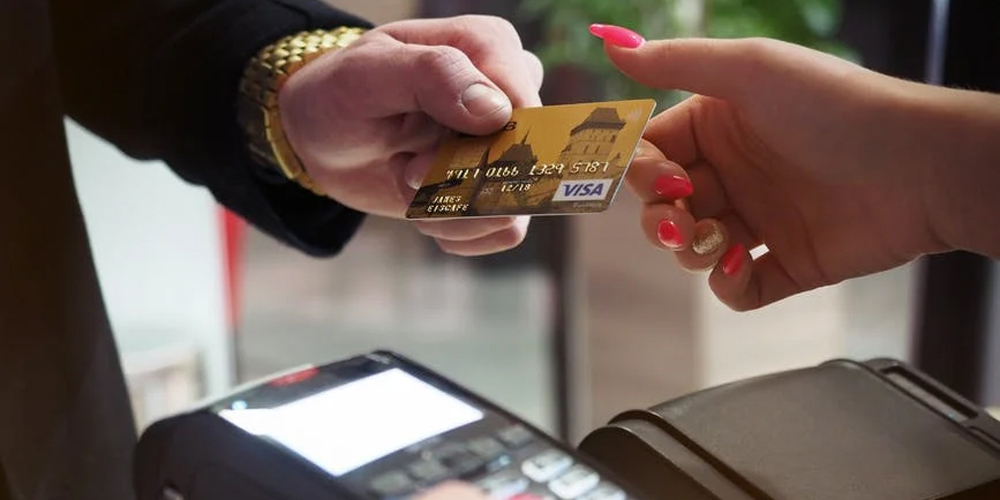
Like everywhere in the world, Credit and Debit Cards also have been commonly used as a method of payment in Indonesia. For practical and convenient reasons Indonesian people, especially those who are living in major cities, commonly keep less cash in hand and used to pay their purchase by Credit or Debit Cards instead. So foreigners traveling to Indonesia need not worry to use credit or debit cards for your traveling pleasure.
What kind of Credit or Debit Cards Acceptable in Indonesia?
Most international credit card networks are acceptable in Indonesia’s major cities and tourist hot-spots like Jakarta, Bandung, Bali, Surabaya, Medan, Yogyakarta, etc.
Cards such as JCB (Japan Credit Bureau) is acceptable in Indonesia because it is affiliated with some of Indonesia’s major well-known bank such as BNI (Bank Negara Indonesia), CIMB Niaga, Mandiri, BRI (Bank Rakyat Indonesia). While American Express (Amex) is also acceptable however Amex has fewer affiliated local banks in Indonesia. Bank Danamon is currently one of the local banks affiliated with Amex. The most widely accepted card in all merchants in Indonesia is Visa and Mastercard.
There will be instances where stores may not display the symbols of the cards they accept. Be sure to check with the salesperson in the store prior to using your card if your card is acceptable or not.
How Much Cash Can I Bring to Indonesia?
Although credit, debit and prepaid cards of well-known brands are generally accepted in the major cities, carrying rupiah in a sufficient amount at hand is highly advisable. Especially when traveling to smaller towns and remote areas, it would probably be quite a problem finding ATMs around and local stores could only accept cash.
The amount of cash allowed into Indonesia or taking it outside the country is at the amount of IDR100,000,000.00 (one hundred million rupiahs) or in other currency that equivalent to this amount. More than this amount, then travelers must declare it to Indonesian Customs.
Which ATMs Could I Withdraw Cash From?
ATM's are widespread throughout Indonesia’s major cities. Cards with Cirrus, Maestro, Plus network seems to be the most prevalent card accepted and could withdraw cash nationwide in most of Indonesia’s major bank ATMs. Cirrus and Maestro logo are associated with Mastercard, while Plus is associated with Visa. Be sure to check if the Cirrus, Maestro or Plus logo is displayed in the ATM machine prior to inserting your card.
JCB cardholder could withdraw cash in Indonesia’s affiliated banks such as BNI (Bank Negara Indonesia), CIMB Niaga, Mandiri, BRI (Bank Rakyat Indonesia). Be sure to check if the JCB or Cirrus Logo is displayed in the ATMs. While American Express cardholders could use the facility of express cash and withdraw cash from Danamon Bank ATMs throughout Indonesia.
Although it is practical to carry credit or debit cards around for your traveling pleasure, when traveling to remote areas and visiting local or traditional markets, it is highly wise and preferable to have some small change at hand for purchasing purposes. This way you are set to have a smooth and fun vacation in Indonesia.
What is the currency of Indonesia?
The official currency of Indonesia is Rupiah which is Issued and controlled by the Bank of Indonesia. The currency code for Rupiahs is IDR, and the currency symbol is Rp. By law, all transactions are required to be conducted in rupiah, and information on the daily exchange rate can be found in newspapers or from the internet and online apps. Credit cards are widely accepted in hotels, large restaurants, and large stores.

Indonesian banknotes issued in denominations of IDR 1.000, 2.000, 5.000, 10.000, 20.000, 50.000, and 100.000. Coins in circulation include IDR 1.000, 500, 200, 100, and 50
Where can I buy and exchange currency?
You can exchange foreign currency in major cities throughout the archipelago at banks and money changers. Most tourists’ resorts have money changer facilities; however, if you are traveling to more remote areas it is advisable to exchange your money beforehand. If you need a large amount of foreign currency, and you don't have a foreign currency account at your bank, it is best to order the money the day before. Local banks keep a limited amount of foreign currency in their smaller branches.
Are ATMs easily accessible?
ATMs on the international Plus/Cirrus or Alto networks are common in all major Indonesian cities and tourist destinations. Limitation withdrawal is depending on your respective home bank. Machines are loaded with IDR.50,000 denomination notes or IDR.100,000 denomination notes, as indicated on the machine; however keep in mind that the bigger notes can be harder to split, especially in rural non-tourist areas. It is also best to withdraw some money from an ATM in major cities before venturing onto more secluded destinations.
Learn also
things you should know before traveling to Indonesia