
Stroke Mechanics
A brief introduction
The golf swing is outwardly similar to many other motions involving swinging a tool or playing implement, such as an axe or a baseball bat. However, unlike many of these motions, the result of the swing is highly dependent on several sub-motions being properly aligned and timed. These ensure that the club travels up to the ball in line with the desired path; that the clubface is in line with the swing path; and that the ball hits the centre or "sweet spot" of the clubface. The ability to do this consistently, across a complete set of clubs with a wide range of shaft lengths and clubface areas, is a key skill for any golfer, and takes a significant effort to achieve.
Accuracy and consistency are typically stressed over pure distance. A player with a straight drive that travels only 220 yards (200 m) will nevertheless be able to accurately place the ball into a favourable lie on the fairway, and can make up for the lesser distance of any given club by simply using "more club" (a lower loft) on their tee shot or on subsequent fairway and approach shots. However, a golfer with a drive that may go 280 yards (260 m) but often does not fly straight will be less able to position their ball advantageously; the ball may "hook", "pull", "draw", "fade", "push" or "slice" off the intended line and land out of bounds or in the rough or hazards, and thus the player will require many more strokes to hole out.
Other notable putting styles include "the claw", a style that has the grip directly in between the thumb and index finger of the dominant hand while the palm faces the target. The weak hand placed normally on the putter. Anchored putting, a style that requires a longer putter shaft that can be anchored into the player's stomach or below the chin; the idea is to stabilize one end of the putter thus creating a more consistent pendulum stroke. This style has been banned on professional circuits since 2016.
Learn More
Stance
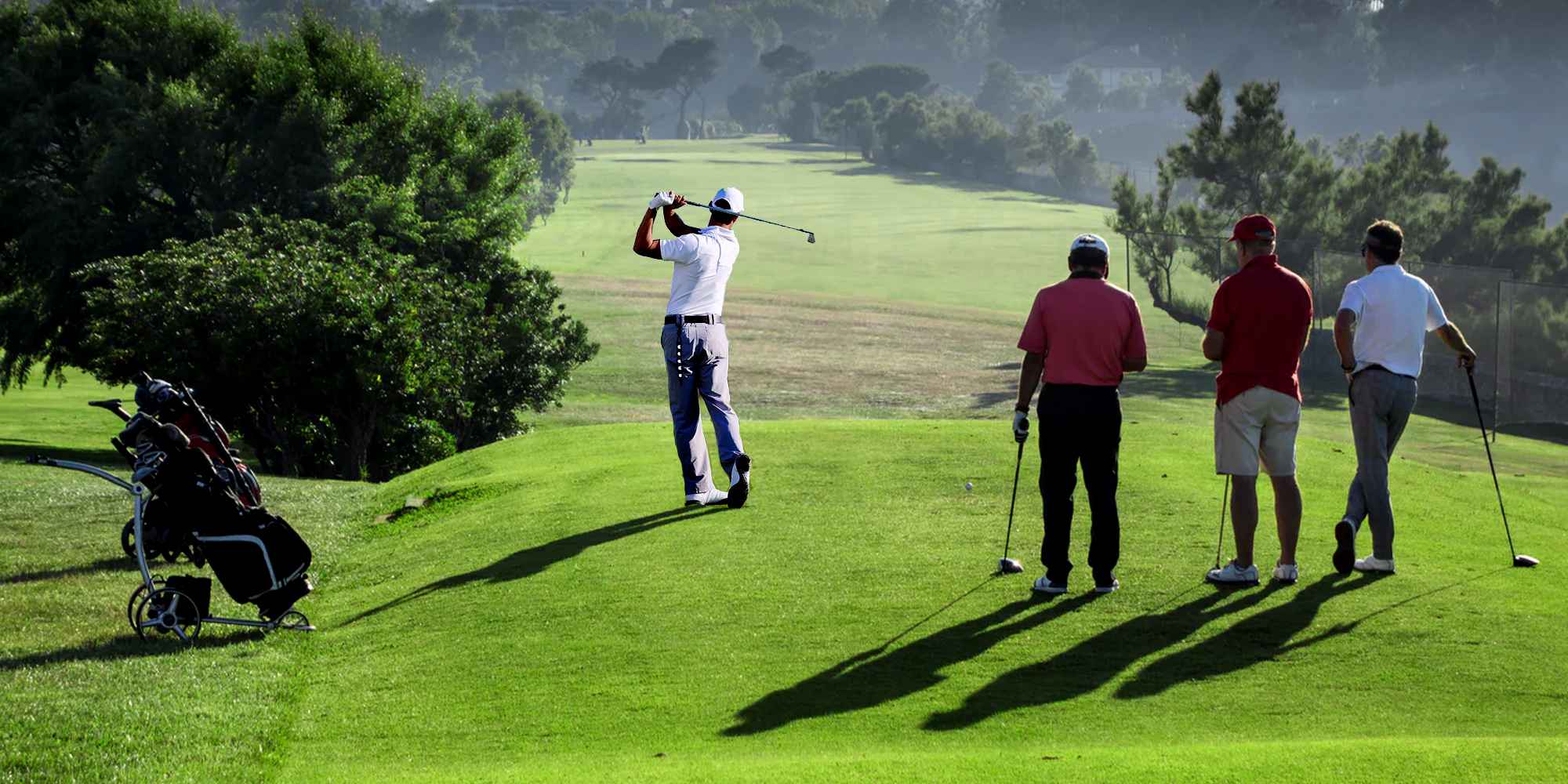
Stance refers to how the golfer positions themselves in order to play a stroke; it is fundamentally important in being able to play a stroke effectively. The stance adopted is determined by what stroke is being played. All stances involve a slight crouch. This allows for a more efficient striking posture whilst also isometrically preloading the muscles of the legs and core; this allows the stroke to be played more dynamically and with a greater level of overall control. When adopting their stance golfers start with the non-dominant side of the body facing the target (for a right-hander, the target is to their left). Setting the stance in regard to the position of the ball, and placing the clubhead behind the ball, is known as being at address; when in this position the player's body and the centerline of the club face are positioned parallel to the desired line of travel, with the feet either perpendicular to that line or slightly splayed outward. The feet are commonly shoulder-width apart for middle irons and putters, narrower for short irons and wider for long irons and woods. The ball is typically positioned more to the "front" of the player's stance (closer to the leading foot) for lower-lofted clubs, with the usual ball position for a drive being just behind the arch of the leading foot. The ball is placed further "back" in the player's stance (toward the trailing foot) as the loft of the club to be used increases. Most iron shots and putts are made with the ball roughly centered in the stance, while a few mid- and short-iron shots are made with the ball slightly behind the centre of the stance to ensure consistent contact between the ball and clubface, so the ball is on its way before the club continues down into the turf.Strokes
The golfer chooses a golf club, grip, and stroke appropriate to the distance:- The "drive" or "full swing" is used on the teeing ground and fairway, typically with a wood or long iron, to produce the maximum distance capable with the club. In the extreme, the windup can end with the shaft of the club parallel to the ground above the player's shoulders.
- The "approach" or "3/4 swing" is used in medium- and long-distance situations where an exact distance and good accuracy is preferable to maximum possible distance, such as to place the ball on the green or "lay up" in front of a hazard. The windup or "backswing" of such a shot typically ends up with the shaft of the club pointing straight upwards or slightly towards the player.
- The "chip" or "half-swing" is used for relatively short-distance shots near the green, with high-lofted irons and wedges. The goal of the chip is to land the ball safely on the green, allowing it to roll out towards the hole. It can also be used from other places to accurately position the ball into a more advantageous lie. The backswing typically ends with the head of the club between hip and head height
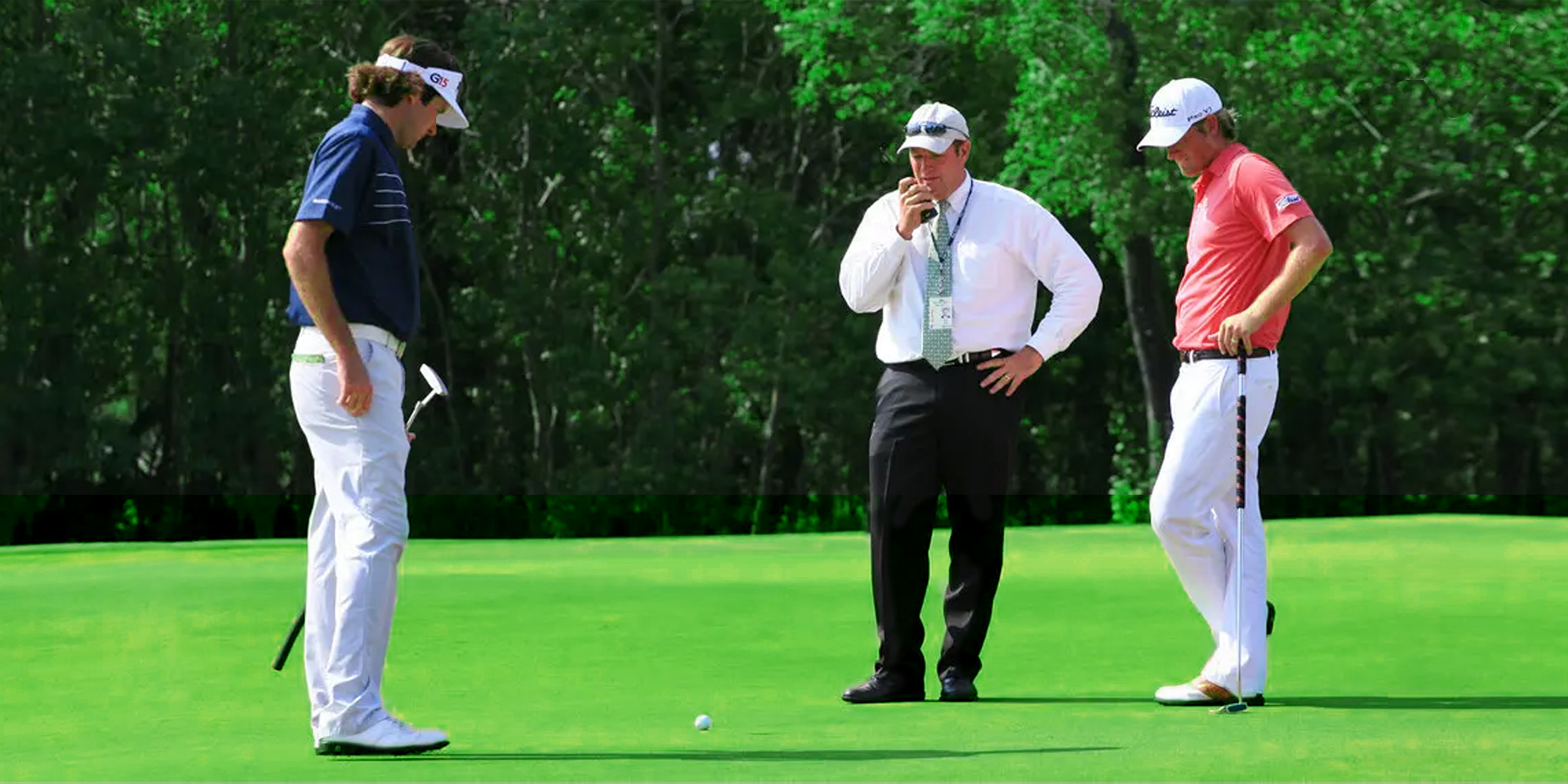
- The "putt" is used in short-distance shots on or near the green, typically made with the eponymous "putter", although similar strokes can be made with medium to high-numbered irons to carry a short distance in the air and then roll (a "bump and run"). The backswing and follow-through of the putt are both abbreviated compared to other strokes, with the head of the club rarely rising above the knee. The goal of the putt is usually to put the ball in the hole, although a long-distance putt may be called a "lag" and is made with the primary intention of simply closing distance to the hole or otherwise placing the ball advantageously.
Accuracy and consistency are typically stressed over pure distance. A player with a straight drive that travels only 220 yards (200 m) will nevertheless be able to accurately place the ball into a favourable lie on the fairway, and can make up for the lesser distance of any given club by simply using "more club" (a lower loft) on their tee shot or on subsequent fairway and approach shots. However, a golfer with a drive that may go 280 yards (260 m) but often does not fly straight will be less able to position their ball advantageously; the ball may "hook", "pull", "draw", "fade", "push" or "slice" off the intended line and land out of bounds or in the rough or hazards, and thus the player will require many more strokes to hole out.
Musculature
A golf stroke uses the muscles of the core (especially erector spinae muscles and latissimus dorsi muscle when turning), hamstring, shoulder, and wrist. Stronger muscles in the wrist can prevent them from being twisted during swings, whilst stronger shoulders increase the turning force. Weak wrists can also transmit the force to elbows and even neck and lead to injury. (When a muscle contracts, it pulls equally from both ends and, to have movement at only one end of the muscle, other muscles must come into play to stabilize the bone to which the other end of the muscle is attached.) Golf is a unilateral exercise that can break body balances, requiring exercises to keep the balance in muscles.Types of putting
Putting is considered to be the most important component of the game of golf. As the game of golf has evolved, there have been many different putting techniques and grips that have been devised to give golfers the best chance to make putts. When the game originated, golfers would putt with their dominant hand on the bottom of the grip and their weak hand on top of the grip. This grip and putting style is known as "conventional". There are many variations of conventional including overlap, where the golfer overlaps the off hand index finger onto off the dominant pinky; interlock, where the offhand index finger interlocks with the dominant pinky and ring finger; double or triple overlap and so on. Recently, "cross handed" putting has become a popular trend amongst professional golfers and amateurs. Cross handed putting is the idea that the dominant hand is on top of the grip where the weak hand is on the bottom. This grip restricts the motion in your dominant hand and eliminates the possibility of wrist breakdowns through the putting stroke.Other notable putting styles include "the claw", a style that has the grip directly in between the thumb and index finger of the dominant hand while the palm faces the target. The weak hand placed normally on the putter. Anchored putting, a style that requires a longer putter shaft that can be anchored into the player's stomach or below the chin; the idea is to stabilize one end of the putter thus creating a more consistent pendulum stroke. This style has been banned on professional circuits since 2016.
Learn More






Georgia Reader Reply
Et rerum totam nisi. Molestiae vel quam dolorum vel voluptatem et et. Est ad aut sapiente quis molestiae est qui cum soluta. Vero aut rerum vel. Rerum quos laboriosam placeat ex qui. Sint qui facilis et.