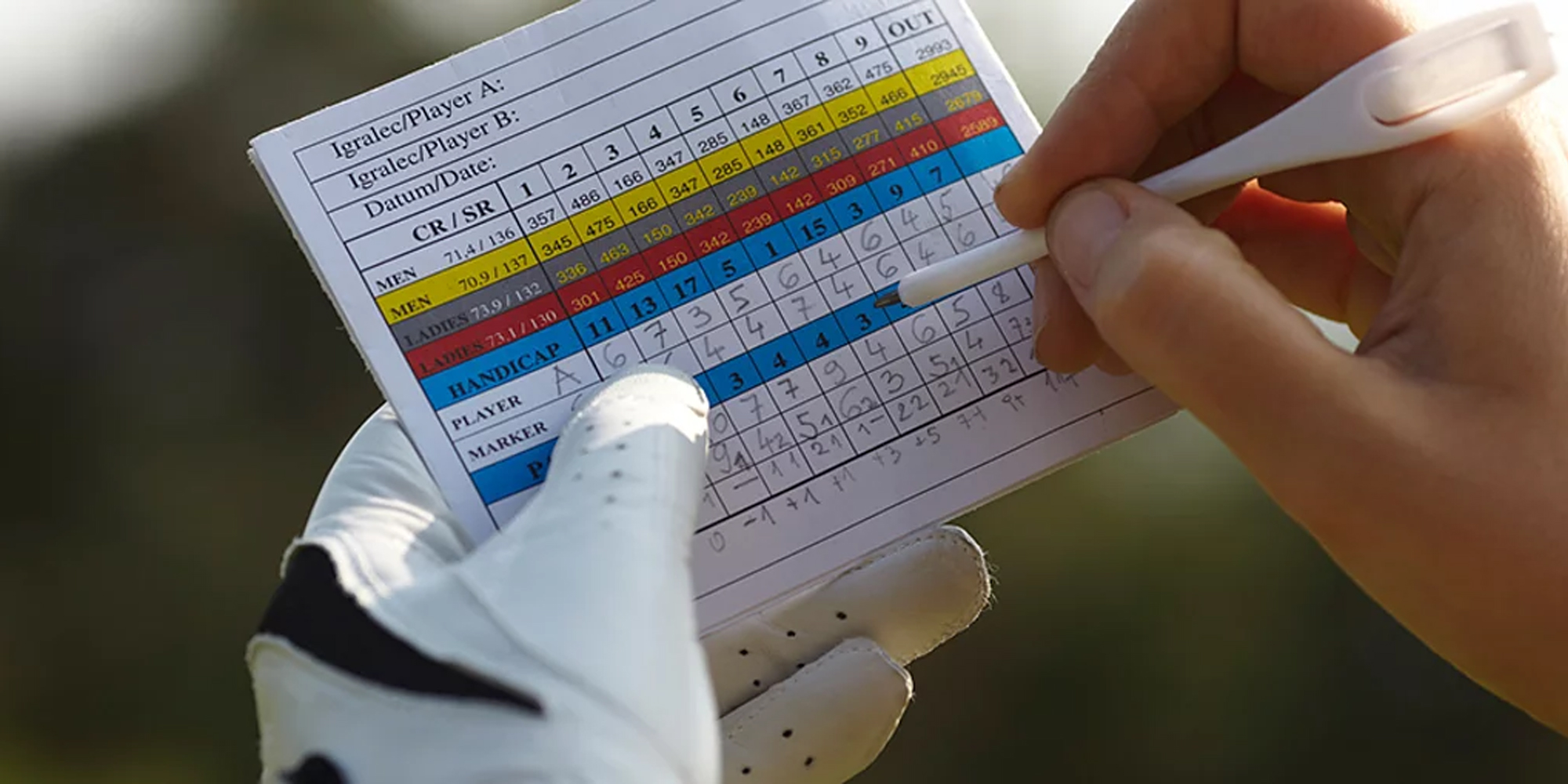

Scoring & Handicapping
A brief introduction
A hole is classified by its par, which gives an indication of the number of strokes a skilled golfer may be expected to need to complete play of the hole. The primary factor for classifying the par of a relatively straight, hazard-free hole is the distance from the tee to the green, and calculates the number of strokes a skilled golfer is expected to require to reach the green with an additional allowance of 2 putts. As such, the minimum par of any hole is 3; one stroke for the tee shot and two putts. Par 3, 4 and 5 holes are commonplace on golf courses; far more rarely, courses may feature par-6 and even par-7 holes.
For men, a typical par-3 hole is less than 250 yards (230 m) in length, with a par-4 hole ranging between 251–450 yards (230–411 m), and a par-5 hole being longer than 450 yards (410 m); for women these boundaries are lower, and for professionals they are much increased. The rare par-6s can stretch well over 650 yards (590 m). These distances are based on the typical scratch golfer's drive distance of between 240 and 280 yards (220 and 260 m). Although length is the primary factor in calculating par, other factors are taken into account; however the number of strokes a scratch golfer should take to make the green remains foremost. Factors affecting the calculation include altitude, gradient of the land from the tee to green, and forced "lay-ups" due to dog-legs (sharp bends) or obstacles (e.g. bunkers, water hazards).
Getting the ball onto the green in two strokes less than par, and hence meeting the par calculation criteria, is called making "green in regulation" or GIR. Missing a GIR does not necessarily mean a golfer will not make par, but it does make doing so more difficult as it reduces the number of putts available; conversely, making a GIR does not guarantee a par, as the player might require three or more putts to "hole out". Professional golfers typically make between 60% and 70% of greens in regulation.
Eighteen-hole courses typically total to an overall par score of 70 to 72 for a complete round; with most holes having a par of 4, and a smaller number of par-3 and par-5 holes. Additionally, courses may be classified according to their play difficulty, which may be used to calculate a golfer's handicap. The two primary difficulty ratings in the U.S. are the Course Rating, which is the expected score for a zero-handicap "scratch golfer", and the Slope Rating, which is a measure of how much worse a "bogey golfer" (handicap around 20) would be expected to play than a "scratch golfer" relative to their handicap.
In a typical professional tournament or among "scratch" amateur players, "birdie-bogey" play is common; a player will "lose" a stroke by bogeying a hole, then "gain" one by scoring a birdie. Eagles are uncommon but not rare; however, only 18 players have scored an albatross in a men's major championship. One of the rarest feats in golf is the condor, which has never occurred in a professional tournament. Only five condors have been verified to have ever occurred, although none of the courses involved were professionally accredited.
There are also variations on the usual starting procedure where everyone begins from the first tee and plays all holes in order, though to the eighteenth. In large field tournaments, especially on professional tours, a two tee start is commonplace, where the field will be split between starting on the first tee and the tenth tee (sometimes the eighth or eleventh depending on proximity to the clubhouse). Shotgun starts are mainly used for amateur tournament or society play. In this variant, each of the groups playing starts their game on a different hole, allowing for all players to start and end their round at roughly the same time. For example, a group starting on hole 5 will play through to the 18th hole and continue with hole 1, ending their round on hole 4.
The USGA and R&A sanction a "Modified Stableford" system for scratch players, which makes par worth zero, a birdie worth 2, eagle 5 and double-eagle 8, while a bogey is a penalty of −1 and a double-bogey or worse −3. As with the original system, the highest score wins the game, and terrible scores on one or two holes will not ruin a player's overall score, but this system rewards "bogey-birdie" play more than the original, encouraging golfers to try to make riskier birdie putt or eagle chipshots instead of simply parring each hole.
Golf courses are assessed and rated according to the average good score of a scratch golfer, taking into account a multitude of factors affecting play, such as length, obstacles, undulations, etc. A player's handicap gives an indication of the number of strokes above this course rating that the player will make over the course of an "average best" round of golf, i.e. scoring near their potential, above average. Lower handicap players are generally the most consistent, so can be expected to play to this standard or better more often than higher handicappers. Some handicap systems also account for differences in scoring difficulty between low and high handicap golfer. They do this by means of assessing and rating courses according to the average good score of a "bogey golfer", a player with a handicap of around 20. This is used with the course rating to calculate a slope rating, which is used to adjust golfer's handicap to produce a playing handicap for the course and set of tees being used.
Handicap systems have potential for abuse by players who may intentionally play badly to increase their handicap (sandbagging) before playing to their potential at an important event with a valuable prize. For this reason, handicaps are not used in professional golf, but they can still be calculated and used along with other criteria to determine the relative strengths of various professional players. Touring professionals, being the best of the best, have negative handicaps; they can be expected, more often than not, to score lower than the Course Rating on any course.
Learn More
For men, a typical par-3 hole is less than 250 yards (230 m) in length, with a par-4 hole ranging between 251–450 yards (230–411 m), and a par-5 hole being longer than 450 yards (410 m); for women these boundaries are lower, and for professionals they are much increased. The rare par-6s can stretch well over 650 yards (590 m). These distances are based on the typical scratch golfer's drive distance of between 240 and 280 yards (220 and 260 m). Although length is the primary factor in calculating par, other factors are taken into account; however the number of strokes a scratch golfer should take to make the green remains foremost. Factors affecting the calculation include altitude, gradient of the land from the tee to green, and forced "lay-ups" due to dog-legs (sharp bends) or obstacles (e.g. bunkers, water hazards).
Getting the ball onto the green in two strokes less than par, and hence meeting the par calculation criteria, is called making "green in regulation" or GIR. Missing a GIR does not necessarily mean a golfer will not make par, but it does make doing so more difficult as it reduces the number of putts available; conversely, making a GIR does not guarantee a par, as the player might require three or more putts to "hole out". Professional golfers typically make between 60% and 70% of greens in regulation.
Eighteen-hole courses typically total to an overall par score of 70 to 72 for a complete round; with most holes having a par of 4, and a smaller number of par-3 and par-5 holes. Additionally, courses may be classified according to their play difficulty, which may be used to calculate a golfer's handicap. The two primary difficulty ratings in the U.S. are the Course Rating, which is the expected score for a zero-handicap "scratch golfer", and the Slope Rating, which is a measure of how much worse a "bogey golfer" (handicap around 20) would be expected to play than a "scratch golfer" relative to their handicap.
Scoring
The goal is to play as few strokes per round as possible. A golfer's number of strokes in a hole, course, or tournament is compared to its respective par score, and is then reported either as the number that the golfer was "under-" or "over-par", or if it was "equal to par". A hole in one (or an "ace") occurs when a golfer sinks their ball into the cup with their first stroke from the tee. Common scores for a hole also have specific terms.| Numeric term | Name | Definition |
|---|---|---|
| −4 | Condor | four strokes under par |
| −3 | Albatross (Double eagle) | three strokes under par |
| −2 | Eagle | two strokes under par |
| −1 | Birdie | one stroke under par |
| E | Par | equal to par |
| +1 | Bogey | one stroke over par |
| +2 | Double bogey | two strokes over par |
| +3 | Triple bogey | three strokes over par |
Basic forms of golf
There are two basic forms of golf play, match play and stroke play. Stroke play is more popular.Match play
Two players (or two teams) play each hole as a separate contest against each other in what is called match play. The party with the lower score wins that hole, or if the scores of both players or teams are equal the hole is "halved" (or tied). The game is won by the party that wins more holes than the other. In the case that one team or player has taken a lead that cannot be overcome in the number of holes remaining to be played, the match is deemed to be won by the party in the lead, and the remainder of the holes are not played. For example, if one party already has a lead of six holes, and only five holes remain to be played on the course, the match is over and the winning party is deemed to have won "6 & 5". At any given point, if the lead is equal to the number of holes remaining, the party leading the match is said to be "dormie", and the match is continued until the party increases the lead by one hole or ties any of the remaining holes, thereby winning the match, or until the match ends in a tie with the lead player's opponent winning all remaining holes. When the game is tied after the predetermined number of holes have been played, it may be continued until one side takes a one-hole lead.Stroke play
The score achieved for each and every hole of the round or tournament is added to produce the total score, and the player with the lowest score wins in stroke play. Stroke play is the game most commonly played by professional golfers. If there is a tie after the regulation number of holes in a professional tournament, a playoff takes place between all tied players. Playoffs either are sudden death or employ a pre-determined number of holes, anywhere from three to a full 18. In sudden death, a player who scores lower on a hole than all of their opponents wins the match. If at least two players remain tied after such a playoff using a pre-determined number of holes, then play continues in sudden death format, where the first player to win a hole wins the tournament.Other formats of play
There are many variations in scoring and playing formats in the game of golf, some officially defined in the Rules of Golf. Variations include the popular Stableford scoring system, and various team formats. Some common and popular examples are listed below.There are also variations on the usual starting procedure where everyone begins from the first tee and plays all holes in order, though to the eighteenth. In large field tournaments, especially on professional tours, a two tee start is commonplace, where the field will be split between starting on the first tee and the tenth tee (sometimes the eighth or eleventh depending on proximity to the clubhouse). Shotgun starts are mainly used for amateur tournament or society play. In this variant, each of the groups playing starts their game on a different hole, allowing for all players to start and end their round at roughly the same time. For example, a group starting on hole 5 will play through to the 18th hole and continue with hole 1, ending their round on hole 4.
Bogey or Par competition
A bogey or par competition is a scoring format sometimes seen in informal tournaments. Its scoring is similar to match play, except each player compares their hole score to the hole's par rating instead of the score of another player. The player "wins" the hole if they score a birdie or better, they "lose" the hole if they score a bogey or worse, and they "halve" the hole by scoring par. By recording only this simple win-loss-halve score on the sheet, a player can shrug off a very poorly-played hole with a simple "-" mark and move on. As used in competitions, the player or pair with the best win-loss "differential" wins the competition.Stableford
The Stableford system is a simplification of stroke play that awards players points based on their score relative to the hole's par; the score for a hole is calculated by taking the par score, adding 2, then subtracting the player's hole score, making the result zero if negative. Alternately stated, a double bogey or worse is zero points, a bogey is worth one point, par is two, a birdie three, an eagle four, and so on. The advantages of this system over stroke play are a more natural "higher is better" scoring, the ability to compare Stableford scores between plays on courses with different total par scores (scoring an "even" in stroke play will always give a Stableford score of 36), discouraging the tendency to abandon the entire game after playing a particularly bad hole (a novice playing by strict rules may score as high as an 8 or 10 on a single difficult hole; their Stableford score for the hole would be zero, which puts them only two points behind par no matter how badly they played), and the ability to simply pick up one's ball once it is impossible to score any points for the hole, which speeds play.The USGA and R&A sanction a "Modified Stableford" system for scratch players, which makes par worth zero, a birdie worth 2, eagle 5 and double-eagle 8, while a bogey is a penalty of −1 and a double-bogey or worse −3. As with the original system, the highest score wins the game, and terrible scores on one or two holes will not ruin a player's overall score, but this system rewards "bogey-birdie" play more than the original, encouraging golfers to try to make riskier birdie putt or eagle chipshots instead of simply parring each hole.
Basic Pairs Formats
- Foursomes (also known as Alternate Shot): defined in Rule 22, this is played in pairs, in which each team has only one ball and players alternate playing it. For example, if players "A" and "B" form a team, "A" tees off on the first hole, "B" will play the second shot, "A" the third, and so on until the hole is finished. On the second hole, "B" will tee off (regardless who played the last putt on the first hole), then "A" plays the second shot, and so on. Foursomes can be played as match play or stroke play.
- Greensomes (also known as Scotch Foursomes): also called modified alternate shot, this is played in pairs; both players tee off, and then pick the best shot. The player who did not shoot the best first shot plays the second shot. The play then alternates as in a foursome. A variant of greensome is sometimes played where the opposing team chooses which of their opponent's tee shots the opponents should use.
- Four-ball: defined in Rules 23, this is also played in pairs, but every each plays their own ball and for each team, the lower score on each hole counts. Four-ball can be played as match play or stroke play.
Team Formats
- Scramble: also known as ambrose or best-shot; each player in a team tees off on each hole, and the players decide which shot was best. Every player then plays their second shot from within a clublength of where the best shot has come to rest (and no closer to the hole), and the procedure is repeated until the hole is finished. This system is very common at informal tournaments such as for charity, as it speeds play (due to the reduced number of shots taken from bad lies), allows teams of varying sizes, and allows players of widely varying skill levels to participate without profoundly affecting team score.
- Best-ball: like four-ball, each player plays the hole as normal, but the lowest score of all the players on the team counts as the team's score for the hole. There are many variations on this format, which count a different number of scores on each hole.
Handicap Systems
A handicap is a numerical measure of a golfer's potential scoring ability over 18 holes. It is used to enable players of widely varying abilities to compete against one another. Better players are those with the lowest handicaps, and someone with a handicap of 0 or less is often referred to as a scratch golfer. Handicap systems vary throughout the world and use different methods to assess courses and calculate handicaps. In order to address difficulties in translating between these systems the USGA and The R&A, working with the various existing handicapping authorities, devised a new World Handicap System which is set to be introduced globally starting in 2020.Golf courses are assessed and rated according to the average good score of a scratch golfer, taking into account a multitude of factors affecting play, such as length, obstacles, undulations, etc. A player's handicap gives an indication of the number of strokes above this course rating that the player will make over the course of an "average best" round of golf, i.e. scoring near their potential, above average. Lower handicap players are generally the most consistent, so can be expected to play to this standard or better more often than higher handicappers. Some handicap systems also account for differences in scoring difficulty between low and high handicap golfer. They do this by means of assessing and rating courses according to the average good score of a "bogey golfer", a player with a handicap of around 20. This is used with the course rating to calculate a slope rating, which is used to adjust golfer's handicap to produce a playing handicap for the course and set of tees being used.
Handicap systems have potential for abuse by players who may intentionally play badly to increase their handicap (sandbagging) before playing to their potential at an important event with a valuable prize. For this reason, handicaps are not used in professional golf, but they can still be calculated and used along with other criteria to determine the relative strengths of various professional players. Touring professionals, being the best of the best, have negative handicaps; they can be expected, more often than not, to score lower than the Course Rating on any course.
Learn More






Georgia Reader Reply
Et rerum totam nisi. Molestiae vel quam dolorum vel voluptatem et et. Est ad aut sapiente quis molestiae est qui cum soluta. Vero aut rerum vel. Rerum quos laboriosam placeat ex qui. Sint qui facilis et.