


2 items, RM 698.069
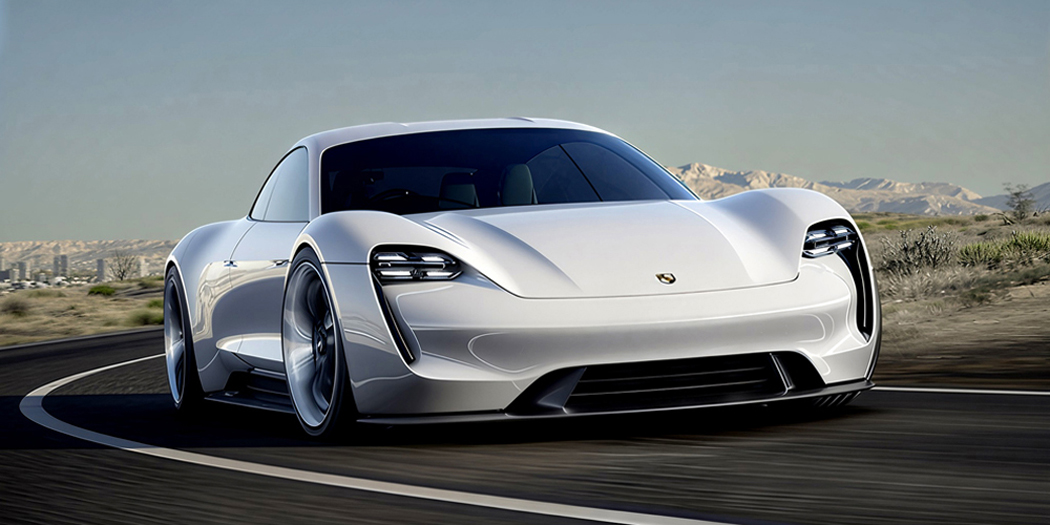
A sports car that covers over 500 kilometers with superb performance—but without a drop of gasoline? Welcome to the future: the electric concept car.
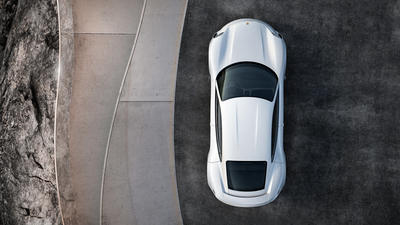 |
| Futuristic elements cannot hide the unmistakable Porsche proportions. |
A possible future. A fascinating future. This concept shows what the first purely electric sports car in the brand’s history could look like. And how it meets every standard in terms of performance, fuel efficiency, driving dynamics, and everyday practicality—based on revolutionary technology. And of course with a timeless, elegant, aesthetic form. In other words, it is the 911 of e-cars. doesn’t just make one statement, but several at once.
Performance
“Our core area of expertise lies in complex, efficient, and high-performance powertrains—just look at the 918 Spyder or 919 Hybrid.” ~ Stefan Weckbach, Project Head
It’s a sports car. There’s no doubt about that. But it’s not the sports car you might expect. Its powertrain is completely new, but, like that of every , is based on technology tested in motorsports. Two permanent magnet synchronous motors (PSMs), similar to those in the 919 Hybrid that won Le Mans, propel the car and recover energy when braking. One of them powers the rear axle, the other the front axle. With a combined output of more than 440 kW (600 hp), they catapult the MissionE to 100 km/h per hour in less than 3.5 seconds, and to 200 km/h in less than 12 seconds. The PSMs are the turbos among electric motors. They convert electrical energy into propulsion very efficiently and smoothly, and build up relatively little heat in the process. This means that they cool down quickly. Whether a has a combustion engine or a purely electric powertrain, it needs to be able to perform on a race track.
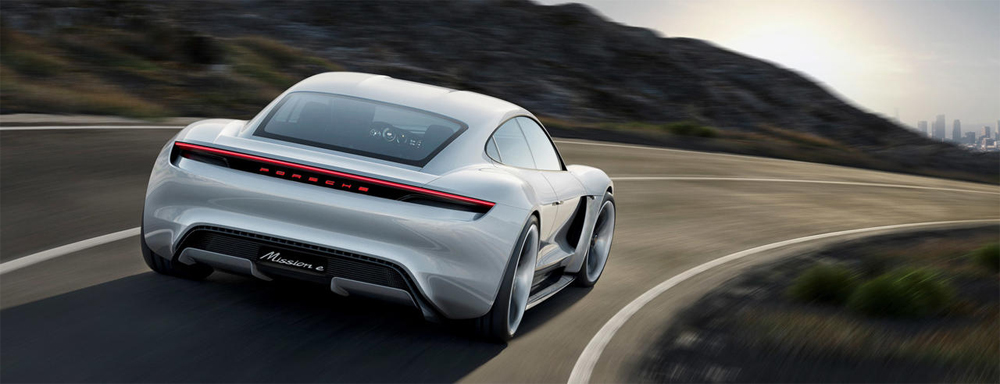 |
| More than 440 kW (600 hp) accelerate the e- from 0 to 100 km/h in under 3.5 seconds. |
Driving pleasure
“The dynamics of driving straight ahead are simple. To appreciate the essence of the sports car concept, look at the curves.” ~ Stefan Weckbach
There’s nothing terribly special about driving very fast in a straight line. What a loves is winding roads and corners. With its superb weight distribution and low center of gravity, the concept is no exception. Its battery lies flat throughout much of the underbody, lowering the car’s center of gravity and enhancing its lateral dynamics. Even weight distribution between front and rear promotes good balance. As a result, the concept’s variable all-wheel drive system with Torque Vectoring can operate to its full potential. It transfers power to the road in keeping with its dynamics and the grip of its 21-inch wheels in front and 22-inch wheels in back. Like 911 GT3 and 911 models, all four wheels help to steer. The can corner even faster and more precisely, while remaining more stable during high-speed lane changes. Derived from the 911 chassis, the active suspension system shares the brand’s famous ability to combine sportiness with comfort. This makes the suitable for the race track. It is expected to lap the Nordschleife of the Nürburgring in less than 8 minutes.
“Fifteen minutes is an acceptable amount of charging time. And with 800 volts, it’s also feasible.” ~ Stefan Weckbach
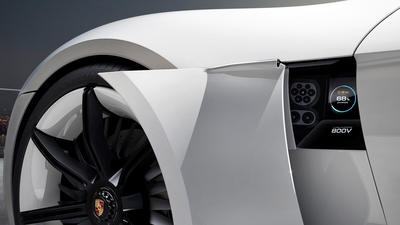 |
| Part of the fender slides open to reveal the charging port. |
calls this concept turbo-charging. Plans are already in place to equip charging stations along German freeways with 800-volt technology. The can make do with less, of course. It can be charged at conventional 400-volt stations, or inductively and conveniently in its own garage. With a coil installed in the garage floor, all the car has to do is park over it for power to be transferred wirelessly to the coil’s counterpart in the underbody.
Refueling of the future.
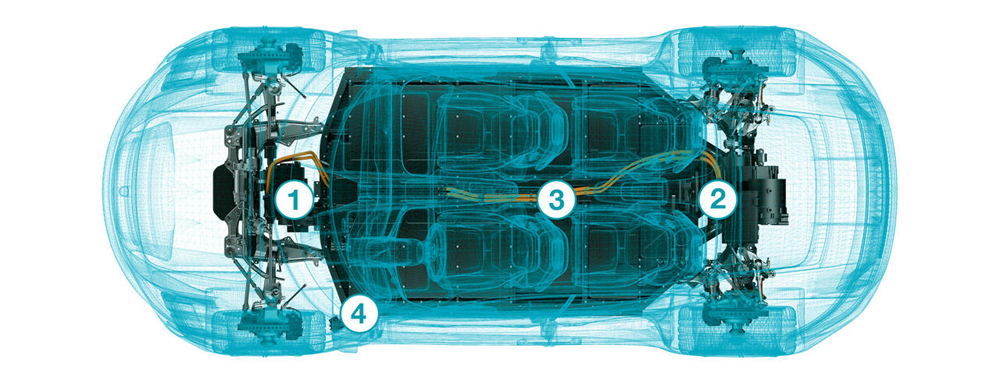
The concept study has two electric motors (1, 2). Its 800-volt powertrain enables short charging times and extended range. The lithium-ion battery (3) is integrated into the underbody, which improves weight distribution and also enables inductive charging. The conventional charging port is located in the front left fender (4).
Design
“The designers’ dream is for the to acquire a status similar to that of the 911.” ~ Michael Mauer, Design Head
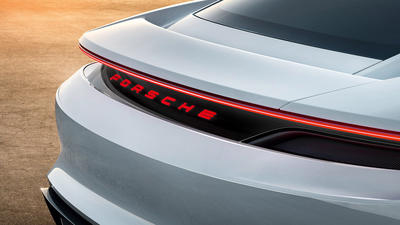 |
| A red arc of light spreads across the back of the car above the backlit |
Every millimeter and every radius should trigger the feeling and the thought that “this can only be a .” The sculpted lines of a sports sedan with a low-slung 130-centimeter roofline combined with the qualities of a sports car from Zuffenhausen.
And then there are the evident innovations such as the integrated aerodynamics. Distinctive air intakes and outlets on the front, sides, and rear showcase the body’s comprehensive flow-through design. After all, even an electric car needs intelligent cooling for its motors, battery, and electronics. Integrated channels enhance the air flow around its wheels, while outlets on the sides play their part in helping to reduce excess pressure in the wheel arches and thus the risk of lift. Once again, form follows function—a principle with a long tradition at .
The classic elements of the clearly evoke its iconic heritage. The arrow-like front is reminiscent of the 918 Spyder, interwoven with the lines of famous race cars. Distinctive front fenders and extremely flat hood lines and side windows show the genes shared with the 911. As on the 911 GT3 RS, a pronounced, broad recess runs from the overlapping front hood up and over the roof. In a word—familiarity.
And now for the thrilling part. Innovative matrix LED headlights with the brand’s characteristic four-point design hover within the air intakes. The four points surround a flat sensor used for driver assistance systems, with a border that serves as a turn signal. The flow of surfaces is not disturbed by side mirrors; instead, cameras are mounted discreetly on the sides. The future beckons. Even the handles on the rear-hinged doors are seamlessly integrated into the outer shell. A continuous arc of red light connects the broad rear fenders, with a back-lit insignia located below it in black glass.
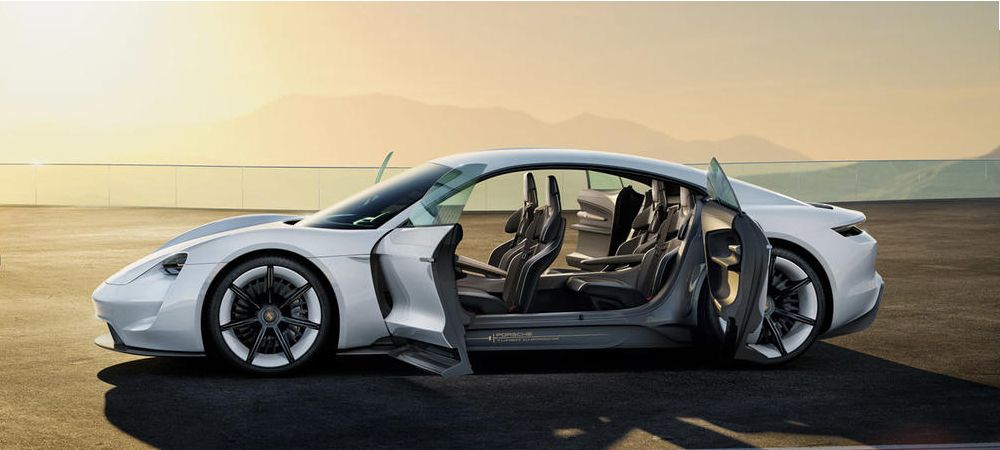 |
| Rear-hinged doors open to reveal the ’s high-tech interior. |
Cockpit
“The concept for the controls is a good indication of how will view connectivity and infotainment in the future.” (Michael Mauer)
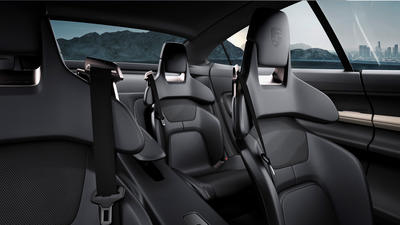 |
| Four extremely lightweight individual seats provide excellent lateral support. |
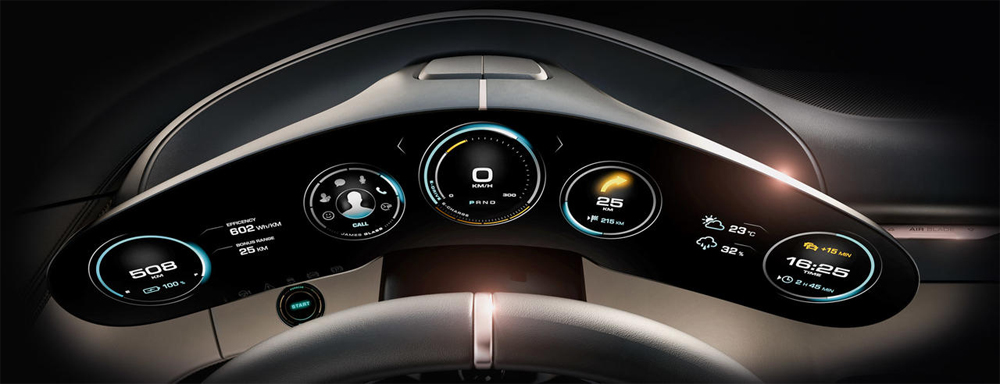 |
| Eye-catcher: A completely new operating concept with an eye-tracking system and gesture control. |
The dashboard is brimming with new ideas as well. Based on the cockpit design of the very first 911, a broad holographic display can be activated with a wave of the hand. The driver or front passenger can then operate the radio, navigation system, climate control, phone, and individual apps in touch-free form. Intuitive gestures, detected by sensors, do the trick. The can also be configured externally via Car Connect. Using “Over the Air and Remote Services” allows owners to modify the car’s functions from their smartphone or tablet. A simple update via the integrated high-speed data module is all it takes to save new infotainment features or engine and suspension settings. Yet another way of charging the car.
Excellent prospects indeed—and a mission that could not be any more fascinating.
By Peter Weidenhammer

Pak Nonki–
2019 Porsche Mission-E is no longer exist: The 2019 Porsche Mission E concept marked the brand's ambitious entry into electric mobility, evolving into the Taycan and influencing subsequent models like the upcoming all-electric Cayenne.
From Mission E to Taycan - Porsche's Electric Genesis: Unveiled at the 2015 Frankfurt Motor Show, the Mission E concept showcased Porsche's vision for high-performance electric vehicles. It featured dual electric motors delivering over 600 horsepower, an 800-volt architecture enabling rapid charging to 80% in about 15 minutes, and a projected range exceeding 500 km.
By 2019, this concept materialized as the Porsche Taycan, retaining much of the Mission E's innovative technology. The Taycan introduced advanced features like a two-speed transmission and regenerative braking, setting new standards for electric sports cars.
Pak Nonki –
The Cayenne's Electric Transformation: Building on the Taycan's success, Porsche is set to launch the fourth-generation Cayenne as a fully electric SUV, expected to debut in late 2025 as a 2026 model. This electric Cayenne will utilize the Premium Platform Electric (PPE), shared with the upcoming Macan EV, and will feature dual motors, all-wheel drive, and fast-charging capabilities. Despite this shift, Porsche plans to continue offering the Cayenne with hybrid and combustion engine variants into the next decade, catering to diverse customer preferences.
A Unified Electric Vision: The evolution from the Mission E to the Taycan, and now to the electric Cayenne, illustrates Porsche's commitment to electrification across its lineup. By leveraging the technological advancements pioneered in the Taycan, Porsche aims to deliver electric vehicles that uphold its legacy of performance and innovation.